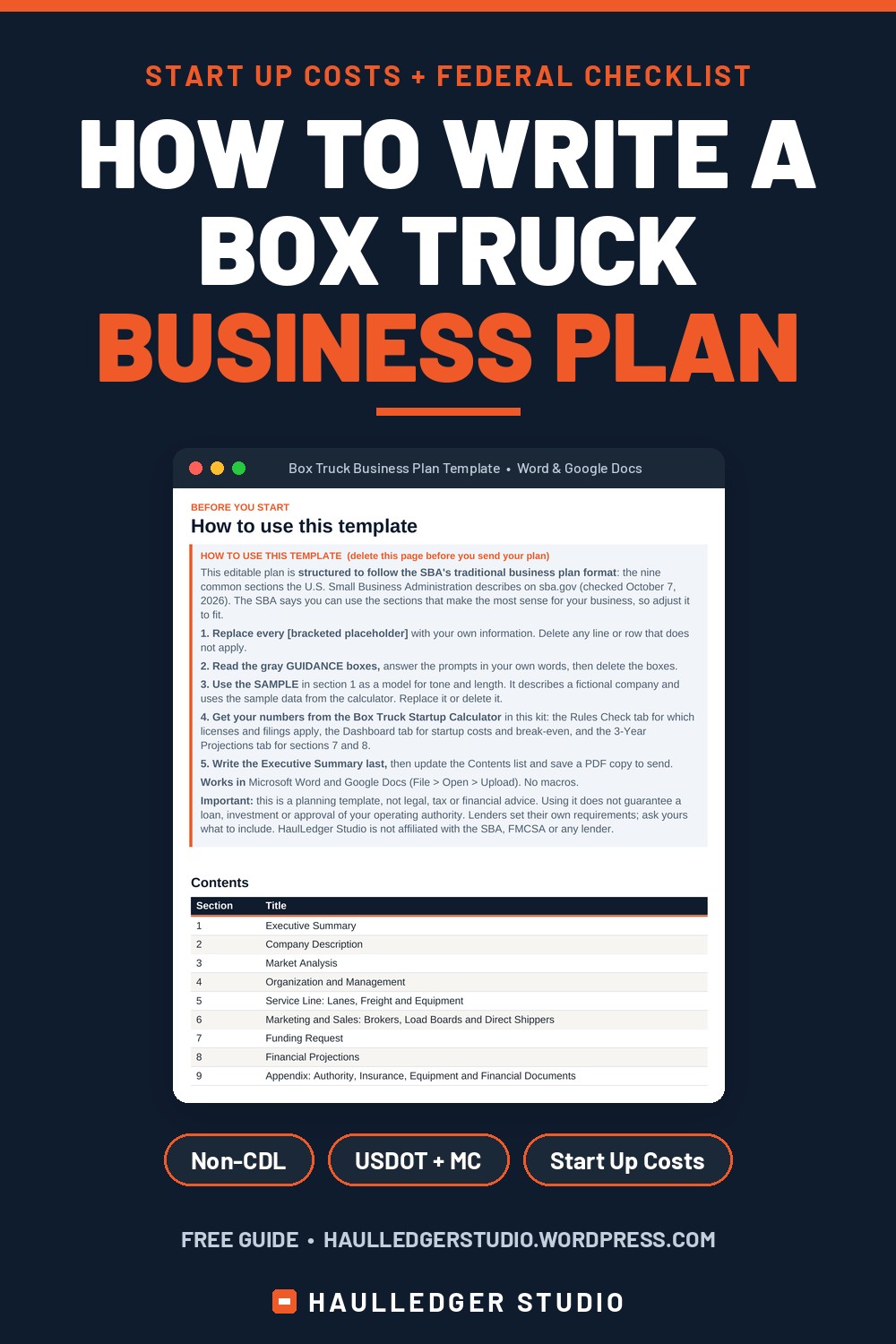
A box truck business plan answers three questions before you spend real money: does your truck need a CDL, which federal registrations apply, and what does it cost to start and keep running? If you’re figuring out how to start a box trucking business, the answers depend mostly on one number, your truck’s gross vehicle weight rating (GVWR). This guide walks through the weight rules, the federal checklist, your box truck business start up costs and a simple plan outline.
New carrier? Run the free DOT check and see your compliance gaps in 2 minutes.
Why a box truck business plan starts with your truck’s weight
Most federal trucking rules switch on at a weight line. Find the GVWR on the driver’s door label before you buy or lease:
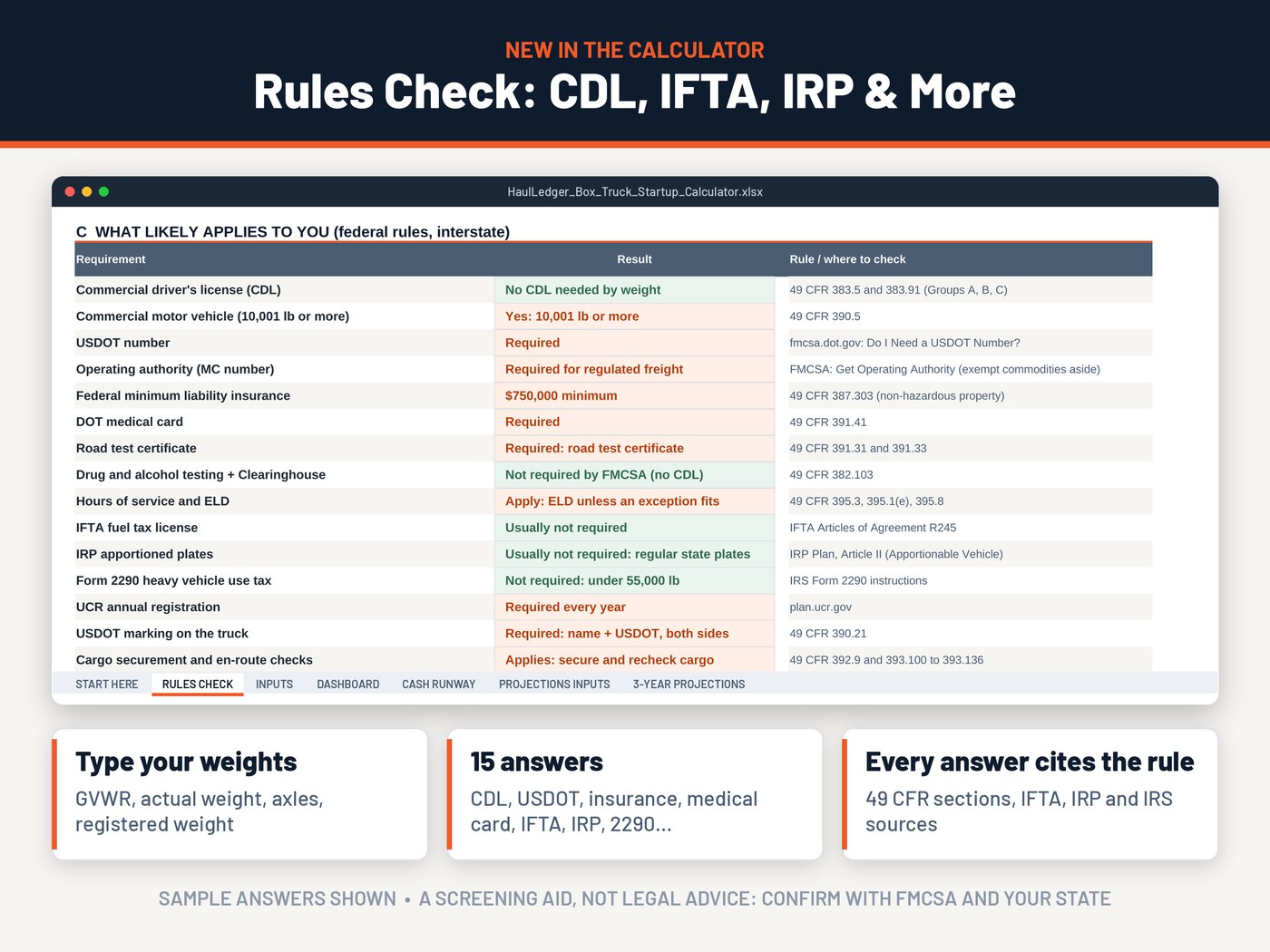
- 10,001 lb or more, in interstate commerce: it’s a commercial motor vehicle. You need a USDOT number, and the driver needs a DOT medical card.
- 26,001 lb or more: the driver needs a CDL (Class B for a single truck).
- Over 26,000 lb with two axles: IFTA fuel tax reporting starts. Three or more axles count at any weight.
- 55,000 lb or more taxable gross weight: the IRS heavy vehicle use tax (Form 2290) applies.
A typical 26 ft box truck rated at 26,000 lb or less is a commercial vehicle, but usually not a CDL, IFTA or 2290 truck.
Free: Know Your Number cost-per-mile calculator. See your break-even rate before you book a load.
Box truck business plan step 1: do you need a CDL?
Under FMCSA’s license classes, a Class B CDL covers any single vehicle with a GVWR or gross vehicle weight of 26,001 lb or more. So a box truck rated at 26,000 lb or less doesn’t need a CDL by weight. You’d still need one to haul placarded hazardous materials, or in a vehicle designed for 16 or more passengers (Class C).
Two cautions:
- The rule says GVWR or actual weight, whichever is greater, so overloading a 26,000 lb truck past 26,000 lb puts you in CDL territory.
- Towing a trailer changes the math. Over 10,000 lb of trailer on a combination of 26,001 lb or more is Class A.
No CDL also means the federal drug and alcohol testing rules (49 CFR Part 382) generally don’t apply, since they cover CDL drivers. The medical card, hours of service and inspections still do.
How to start a box trucking business: the federal checklist for your box truck business plan
Hauling other people’s freight across state lines for pay? This is the usual order:
- Form your business (LLC or sole proprietor) with your state, then get a free EIN from the IRS.
- Get a USDOT number. It’s required for interstate trucks of 10,001 lb or more, and FMCSA says there’s no charge for it. Many states, including Florida, Texas and California, also require one for intrastate carriers.
- Apply for operating authority (MC number) if you’ll haul federally regulated commodities owned by others for pay. FMCSA charges $300 per authority and doesn’t refund mistaken applications. New applications take about 20 to 25 business days, or 8+ weeks if pulled for extra review.
- File your BOC-3. Only a process agent can file it for a carrier, and it must name an agent for each state you operate in or through.
- Get insurance on file. For-hire, non-hazardous carriers need $750,000 in liability coverage for vehicles of 10,001 lb GVWR or more ($300,000 if every vehicle is under 10,001 lb). Your insurer must file it within 20 days of your application showing up in the FMCSA Register, or your application faces dismissal.
- Register for UCR each year with your base state. The 2027 fee for a carrier with 0 to 2 vehicles is $55, due before January 1.
- Set up your driver file and inspections: medical card, application, MVR and road test certificate. Our driver qualification file guide covers the full list, and our pre-trip inspection checklist has a box truck section.
Then comes FMCSA’s New Entrant program: 18 months of monitoring, with a safety audit within 12 months of starting operations.
Box truck business start up cost: what goes in your box truck business plan
Your box truck business start up cost is mostly the truck, insurance and cash to last until brokers pay. Federal fees are the small part:
| Startup item | What it costs |
|---|---|
| USDOT number | $0 (FMCSA) |
| Operating authority (MC) | $300 per authority (FMCSA) |
| UCR, 0 to 2 vehicles | $55 for 2027 (UCR Plan) |
| BOC-3 process agent | Agent’s fee, get quotes |
| Liability insurance ($750,000 minimum) | Get quotes; often the biggest monthly bill |
| Truck: buy or lease, plus liftgate | Your quote |
| LLC filing, plates, ELD, phone, gear | Your state and vendor prices |
| Working capital | Several weeks of fuel, payments and pay |
Your truck, state and insurance quote swing the total more than anything else, so use real quotes, not someone else’s number.
For running costs, ATRI’s 2026 update put the average operational cost of trucking at $2.336 per mile for 2025. That survey is mostly tractor-trailer fleets, so use it as a reality check, not your number. Work out your own with our trucking cost per mile guide.
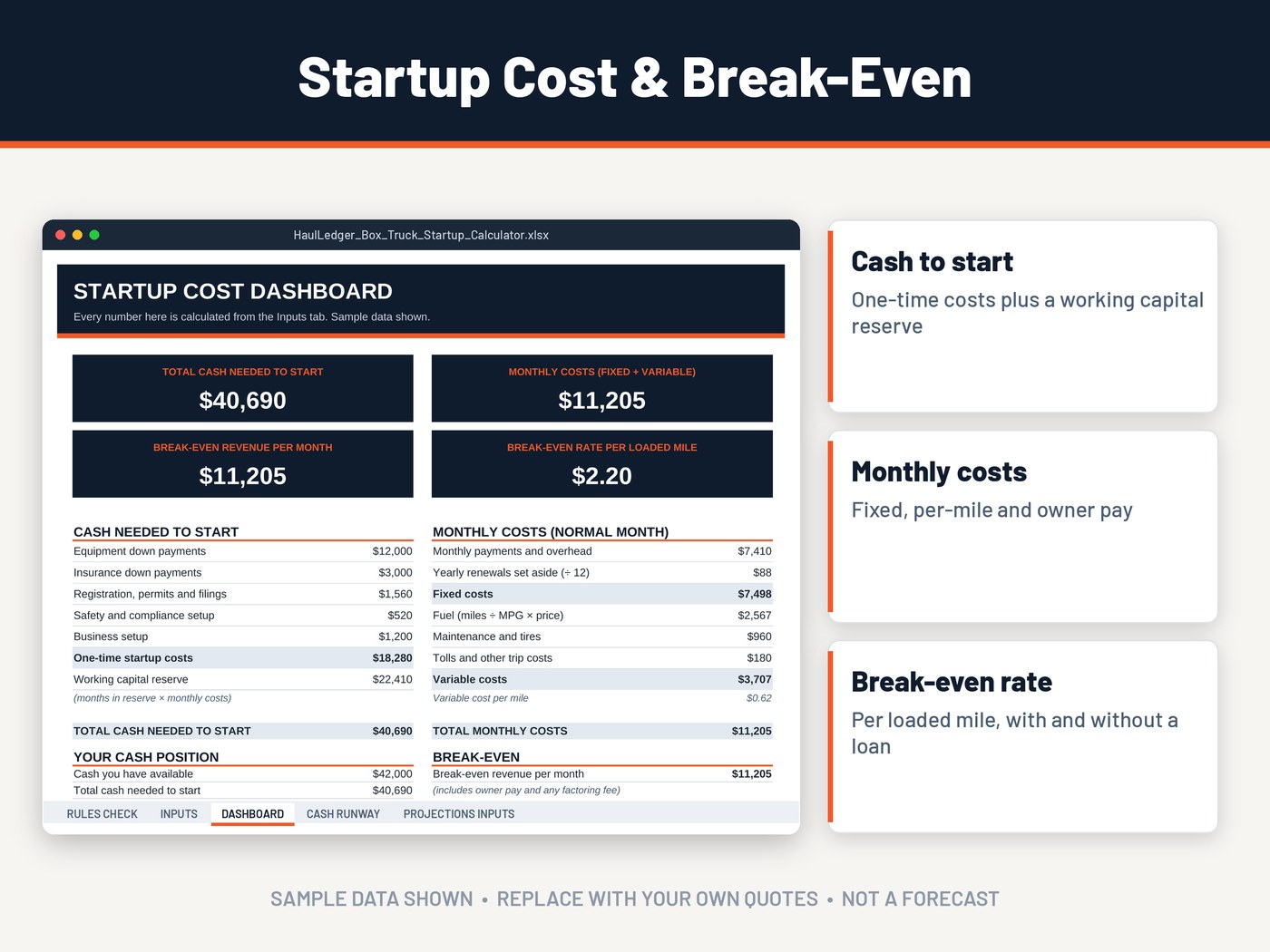
Want the numbers done for you? The HaulLedger Box Truck Business Plan & Startup Kit has a Rules Check tab that turns your truck’s weights into cited CDL, USDOT, IFTA and 2290 answers, a startup cost and break-even calculator, a plan template in Word and Google Docs, and checklists.
What to put in your box truck business plan (9 sections)
Use the same nine sections the SBA lists for a traditional business plan (our trucking business plan guide explains each one), with a box truck focus:
- Executive summary: what you haul, where, and how much cash you need. Write it last.
- Company description: your LLC, USDOT and MC status, and your truck’s GVWR (and why it’s non-CDL).
- Market analysis: final mile, expedite, LTL partials or freight programs, and your competition.
- Organization: who handles dispatch, billing, maintenance and safety.
- Service line: truck size, liftgate and service area.
- Marketing and sales: load boards, broker setups, direct shippers, local businesses.
- Funding request: only if you’re borrowing.
- Financial projections: loaded miles × rate, costs per mile, profit, and a monthly cash runway for year one.
- Appendix: insurance quotes, truck specs, authority documents.
One trap: moving household goods for individual customers is a more regulated business with its own cargo insurance filing. Check those rules before you take furniture work.
Free: Know Your Number cost-per-mile calculator. See your break-even rate before you book a load.
Box truck business plan FAQ
Do I need a CDL to drive a 26 ft box truck? Not by weight if its GVWR and actual weight stay at 26,000 lb or less and you don’t haul placarded hazmat.
Do I need a USDOT number for a box truck? Yes, if it’s rated 10,001 lb or more and you operate in interstate commerce. Many states also require one for intrastate work.
Do I need an MC number for a box truck? You need operating authority if you haul federally regulated freight owned by others, for pay, across state lines. Private carriers and exempt-commodity haulers don’t.
Does a box truck need IFTA or Form 2290? Usually not. IFTA covers two-axle trucks over 26,000 lb, and Form 2290 starts at 55,000 lb taxable gross weight.
How much insurance does a box truck business need? The federal minimum is $750,000 in liability for for-hire, non-hazardous trucks of 10,001 lb GVWR or more. Many brokers ask for more.
How much does it cost to start a box truck business? The federal fees are small ($300 for authority, $55 UCR for 2027, $0 for USDOT). The truck, insurance and working capital are the real costs, so get quotes.
Put your box truck business plan on paper
Check the door label, work the federal checklist, then price your startup with real quotes. For the calculator, plan template and checklists ready to fill in, the Box Truck Business Plan & Startup Kit has them in Excel, Google Sheets and Word.
Not legal, tax or financial advice. Rules and fees change and state rules vary, so verify with FMCSA, the IRS and your state, and talk to a qualified professional before you buy a truck or file.
Sources (checked October 2026)
- FMCSA, Do I Need a USDOT Number? and AskFMCSA registration FAQ (no charge for a USDOT number)
- FMCSA, Get Operating Authority ($300 fee, timing), Form BOC-3, Insurance Filing Requirements
- FMCSA, CDL classes for drivers and New Entrant Safety Assurance Program
- eCFR, 49 CFR 390.5 (CMV definition), 382.103 (drug and alcohol testing applicability), 391.41 (medical certificate)
- UCR Plan, Fee Brackets (2027 fees)
- IRS, About Form 2290 and Get an EIN
- IFTA, Inc., Articles of Agreement, R245 (qualified motor vehicle)
- SBA, Write your business plan
- ATRI, Analysis of the Operational Costs of Trucking: 2026 Update (July 2026), Table 8