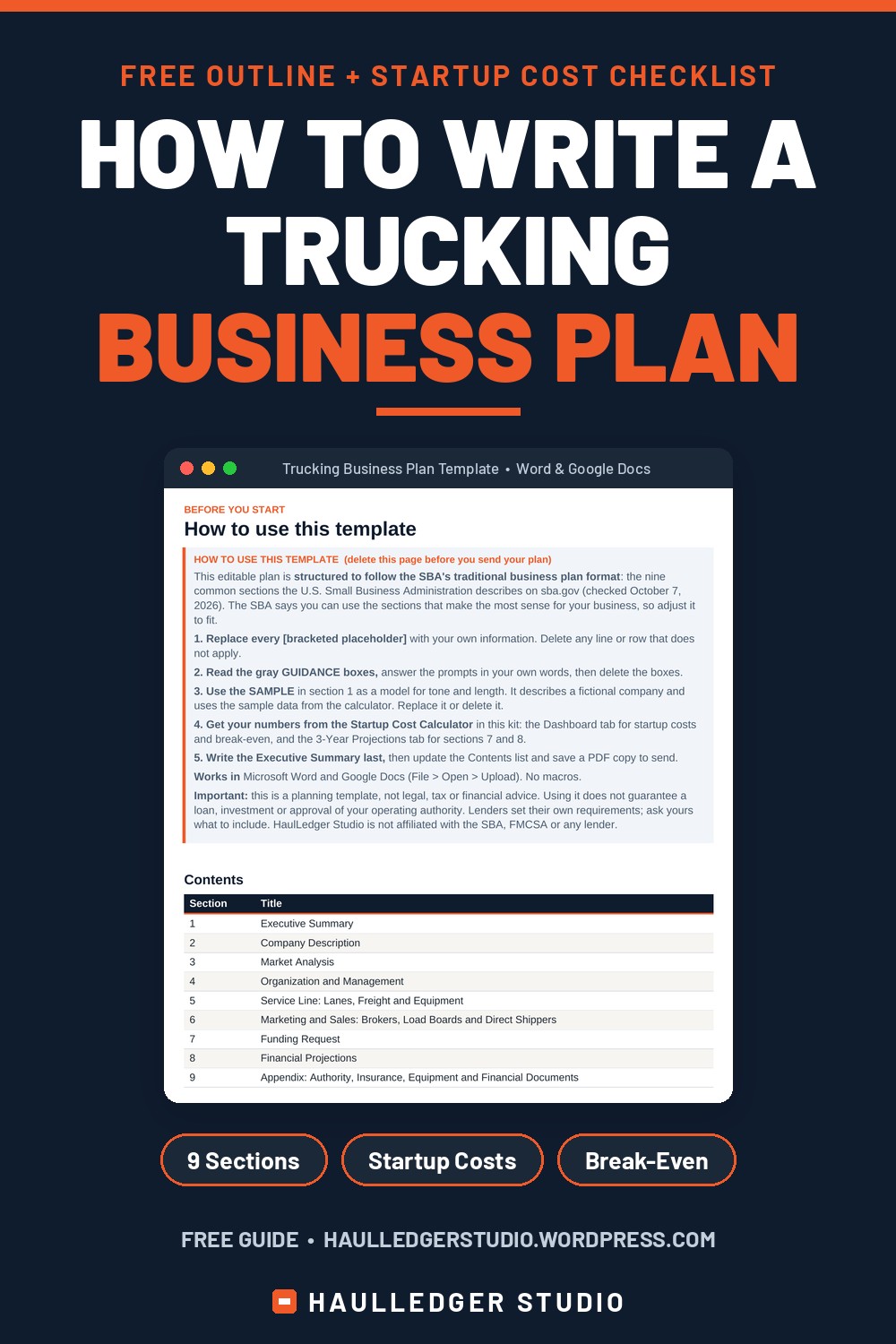
A trucking business plan is just your game plan on paper: what you’ll haul, where, with what truck, what it costs to get rolling, and what rate per mile keeps you in business. You don’t need an MBA to write one. Below is a free trucking business plan outline in the same 9-section format the U.S. Small Business Administration (SBA) describes, plus a startup cost checklist so you don’t get blindsided after you get your authority.
New carrier? Run the free DOT check and see your compliance gaps in 2 minutes.
Why you need a trucking business plan (even if you’re not borrowing)
If you want a loan, an equipment lender or bank will likely ask for a plan and your numbers. But the bigger reason is for you. Writing a trucking business plan forces you to answer the hard questions before you spend $300 on an authority application and thousands on insurance down payments:
- How much cash do I need to start, and how long can I last before broker payments catch up?
- What does my truck cost to run per mile, and what’s the lowest rate I can take?
- Which lanes, freight and customers am I going after?
New carriers also go through FMCSA’s New Entrant program. FMCSA monitors you for your first 18 months, and a safety audit happens within 12 months of starting operations. A plan that includes your compliance setup (drug and alcohol testing, hours of service, vehicle inspections) helps you pass it.
Free: Know Your Number cost-per-mile calculator. See your break-even rate before you book a load.
The trucking business plan outline (9 sections)
The SBA lists nine common sections for a traditional business plan, and says you can use the sections that make the most sense for your business. Here’s what each one means for a trucking company:
- Executive summary. One page: who you are, what you haul, your equipment, your lanes, and how much money you need (if any). Write it last.
- Company description. Your legal name, LLC or sole proprietor, home base, USDOT and MC status, and what makes you dependable (safety record, years driving, specialty freight).
- Market analysis. The freight you’ll target (dry van, reefer, flatbed, box truck, hotshot), the lanes, who ships it, and who you compete with.
- Organization and management. Who runs dispatch, billing, safety and maintenance. For a one-truck owner-operator, that’s mostly you, so say who backs you up (dispatcher, accountant, factoring company).
- Service line. Equipment details, freight types, service area and any extras like liftgate or team runs.
- Marketing and sales. How you’ll find loads: load boards, broker setups, direct shippers, referrals.
- Funding request. Only if you’re borrowing: how much, what for, and the terms you want.
- Financial projections. Revenue (miles × rate), costs, profit and cash flow. The SBA suggests a five-year outlook with the first year monthly or quarterly. Plenty of small carriers start with three years. Ask your lender what they want.
- Appendix. Copies of your authority, insurance quotes, truck and trailer details, credit info, and anything else a lender asks for.
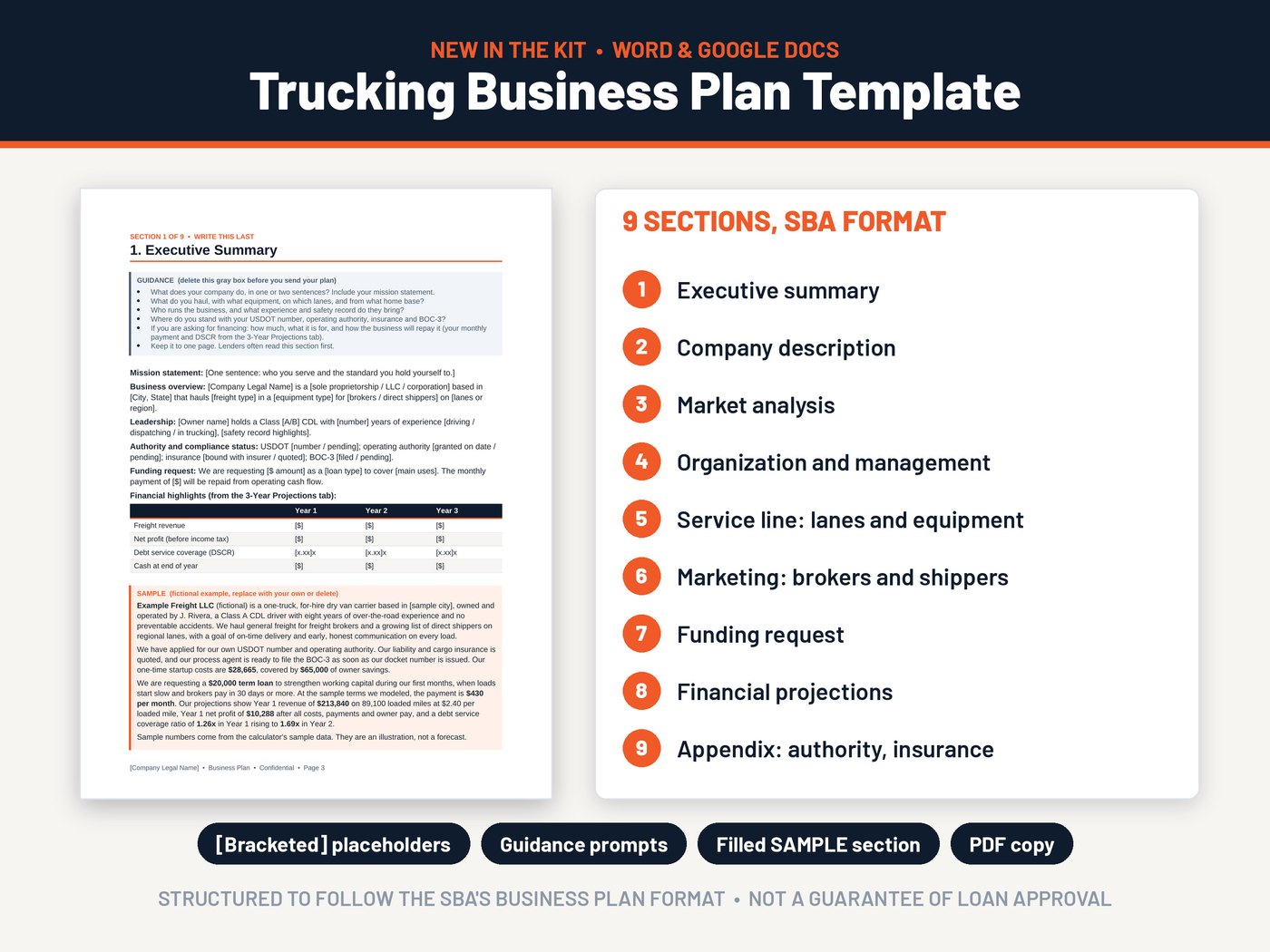
Want a head start? The HaulLedger Trucking Business Plan & Startup Kit has this outline as an editable Word and Google Docs template, with prompts in every section and a filled sample executive summary. You can still write the whole thing yourself using the outline above.
Trucking business plan startup cost checklist
Your trucking business plan is only as good as the numbers in it. Use this checklist to price your startup. Fees change, so check each one with the official source before you count on it.
Business setup – ☐ LLC or other business filing (your state’s fee) – ☐ EIN from the IRS (free at irs.gov) – ☐ Business bank account
Authority and filings (interstate for-hire) – ☐ USDOT number and operating authority through FMCSA’s registration system (Motus). The authority fee is $300 for each type of authority, and FMCSA doesn’t refund it. – ☐ BOC-3 process agent filing (only a process agent can file it for you) – ☐ Insurance filing. For-hire carriers hauling general freight in vehicles of 10,001 pounds or more need at least $750,000 in liability coverage, and your insurer has to file proof with FMCSA. – ☐ UCR registration (yearly, fee based on fleet size) – ☐ IRP apportioned plates and an IFTA license with decals (through your base state) – ☐ IRS Form 2290 heavy vehicle use tax if your truck is 55,000 pounds or more
Safety and compliance – ☐ Drug and alcohol testing program. Owner-operators with their own authority have to join a random testing pool, register in the FMCSA Drug & Alcohol Clearinghouse, and get a negative pre-employment test before driving. – ☐ Registered ELD (unless you qualify for an exception) – ☐ Medical card, driver qualification file, and an annual inspection on every truck and trailer
Equipment and operating cash – ☐ Truck and trailer down payments, or full price – ☐ Insurance down payment plus monthly premiums. Cargo and physical damage coverage aren’t part of the federal minimum, but brokers and lenders often require them. – ☐ First fuel, tolls, repairs reserve and tires – ☐ Working cash to cover the weeks before broker payments come in (or your factoring cost)
Financial projections in your trucking business plan
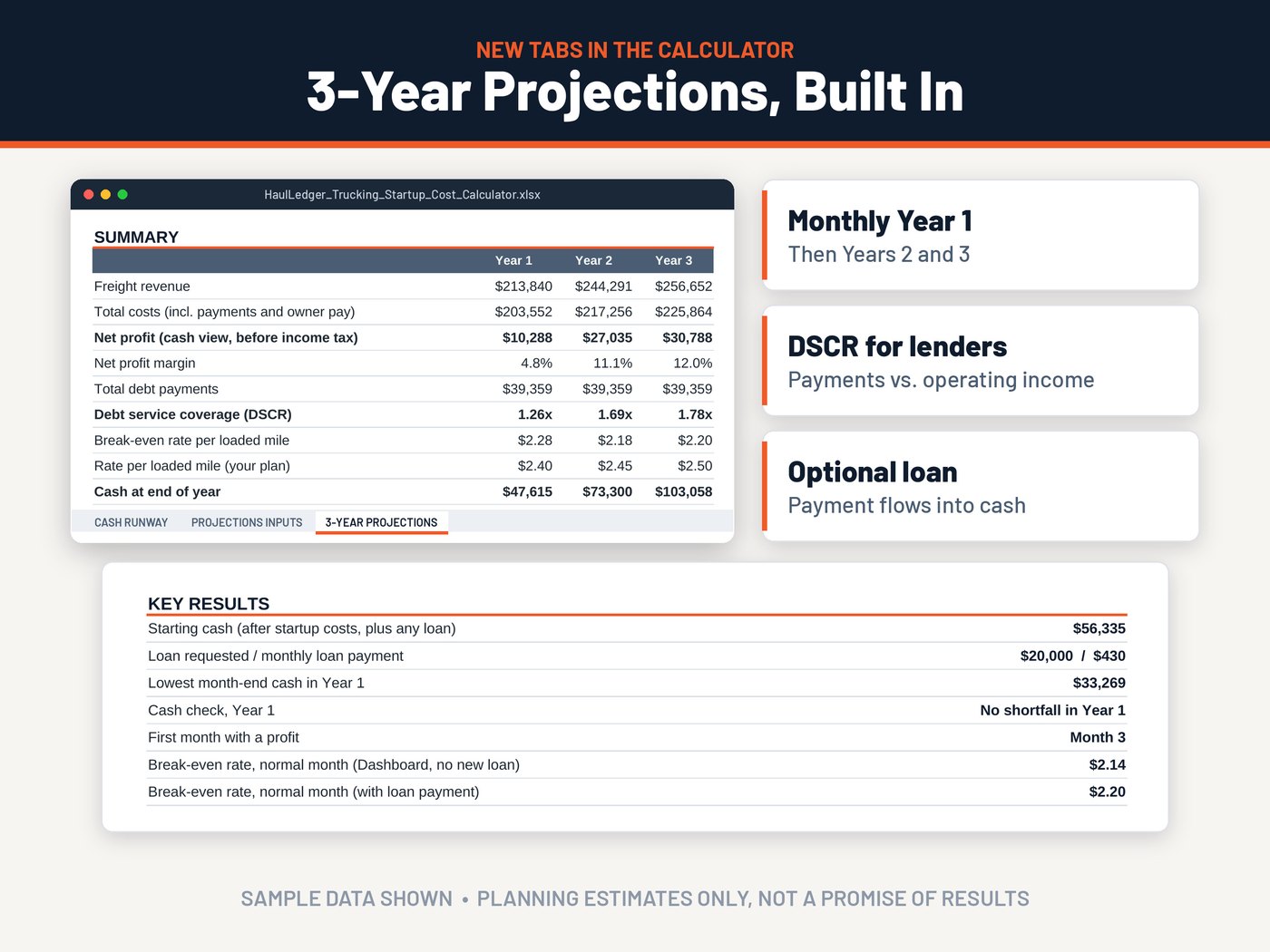
This is the part most new carriers skip, and it’s the part lenders read first. You need three numbers:
- Total cash to start: every one-time cost from the checklist plus your first few months of fixed bills.
- Cost per mile: everything you spend in a month divided by the miles you run. (Here’s our step-by-step guide: How to Calculate Your Trucking Cost Per Mile.)
- Break-even rate per loaded mile: the lowest rate that covers all costs, including your own pay.
For a gut check, the American Transportation Research Institute (ATRI) found the average cost to run a truck in 2025 was a record $2.336 per mile. That’s an industry average across fleets, not your number, but if your plan shows costs way below it, check your math again.
Trucking business plan mistakes to avoid
- Leaving out your own pay. If the truck only “makes money” when you work for free, it doesn’t make money.
- Counting only loaded miles. Deadhead miles burn fuel too.
- Forgetting the wait to get paid. Many brokers pay weeks after delivery unless you use quick pay or factoring, so plan cash for that gap.
- Treating fees as fixed. UCR, insurance and plate costs change. Get real quotes.
- Planning for best-case months only. Add a slow month or two to your first year.
Free: Know Your Number cost-per-mile calculator. See your break-even rate before you book a load.
Trucking business plan FAQ
Do I need a business plan to get my MC number? No. FMCSA doesn’t ask for one. You need it for lenders, investors, some equipment financing, and to know your own numbers.
How long should a trucking business plan be? Long enough to answer the nine sections clearly. For a small carrier, that’s often 10 to 20 pages including tables. Keep the executive summary to one page.
Can I write a trucking business plan for a box truck or hotshot? Yes. The outline is the same. Your equipment, freight, insurance and whether you need IRP, IFTA or Form 2290 can change depending on truck weight and whether you run interstate.
How much does it cost to start a trucking company? It depends on whether you buy or lease equipment, your insurance quote and your state. Price each line on the checklist above with real quotes instead of trusting an online average.
Will a business plan guarantee a loan? No. Lenders set their own requirements. A clear plan with honest numbers just gives you a better shot.
Ready to write your trucking business plan?
If you’d rather fill in blanks than start from a blank page, the Trucking Business Plan & Startup Kit includes the 9-section plan template (Word and Google Docs), a startup cost calculator with break-even and 3-year projections, a new authority guide and printable checklists. Plug in your own quotes and you’ll have your numbers in an afternoon.
Not legal, tax or financial advice. Rules and fees change, so check with FMCSA, the IRS, your state and your own accountant or attorney before you file or buy. HaulLedger Studio isn’t affiliated with the SBA or FMCSA.
Sources (checked October 2026)
- SBA, Write your business plan
- FMCSA, Get Operating Authority and Move to Motus
- FMCSA, Insurance Filing Requirements
- FMCSA, BOC-3 Designation of Agents
- FMCSA, New Entrant Safety Assurance Program
- FMCSA Clearinghouse, Owner-operator obligations
- UCR, Fee brackets; IFTA, Carriers
- IRS, About Form 2290 and Get an EIN
- ATRI, Analysis of the Operational Costs of Trucking: 2026 Update