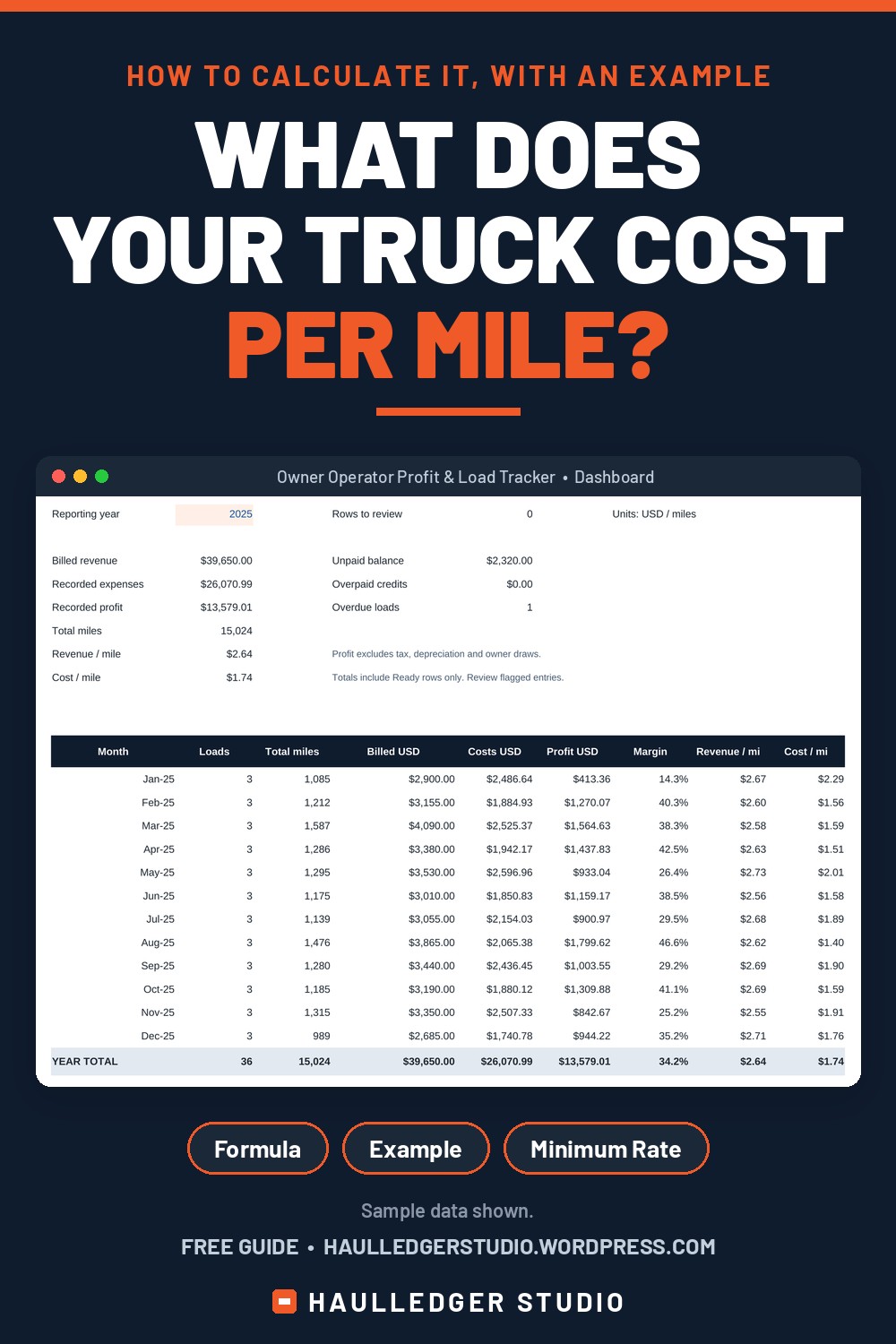
Your trucking cost per mile is the one number that tells you whether a load makes you money or just keeps the wheels turning. Brokers quote you a rate per mile, so you need to know your cost per mile to answer back. This guide shows the simple formula, walks through a full example with real-looking numbers, and shows you how to turn your cost into a minimum rate you can quote with confidence.
New carrier? Run the free DOT check and see your compliance gaps in 2 minutes.
What is trucking cost per mile?
Trucking cost per mile (CPM) is everything it costs to run your truck for a period, divided by the miles you drove in that period. It includes fixed costs you pay whether the truck moves or not, and variable costs that go up with every mile.
- Fixed costs: truck and trailer payments, insurance, plates and permits, ELD and phone, parking, accounting, and the yearly fees (UCR, IFTA, Form 2290) spread out by month.
- Variable costs: fuel, maintenance and repairs, tires, tolls, and DEF.
- Your pay: if you’re an owner-operator, count what you need to take home as a cost. If the truck only breaks even when you work for free, it isn’t breaking even.
Free: Know Your Number cost-per-mile calculator. See your break-even rate before you book a load.
The trucking cost per mile formula
Cost per mile = total costs for the month ÷ total miles for the month
Use total miles, loaded plus deadhead, for your true cost per mile. Then work out a second number, cost per loaded mile (total costs ÷ loaded miles only), because brokers pay you for loaded miles. Every empty mile pushes that second number up.
Use a full month (or better, a full quarter) of real numbers from your bank statements, fuel card and settlement sheets. One week is too short. A tire or a repair bill can swing it wildly.
Trucking cost per mile example, step by step
Here’s an example for a solo owner-operator with a used semi and a dry van trailer. These are made-up example numbers, not quotes. Plug in your own.
Step 1: Add up your miles for the month – Loaded miles: 8,500 – Deadhead miles: 1,500 (15% empty) – Total miles: 10,000
Step 2: Add up fixed costs
| Fixed cost (monthly) | Amount |
|---|---|
| Truck payment | $2,200 |
| Trailer payment | $650 |
| Insurance | $1,250 |
| ELD, phone, load board | $100 |
| Plates, permits, UCR, IFTA, Form 2290 (yearly costs ÷ 12) | $250 |
| Total fixed | $4,450 |
Step 3: Add up variable costs
| Variable cost | How it’s figured | Amount |
|---|---|---|
| Fuel | 10,000 mi ÷ 6.5 mpg × $3.85/gal | $5,923 |
| Maintenance reserve | 10,000 mi × $0.18 | $1,800 |
| Tires | 10,000 mi × $0.05 | $500 |
| Tolls | actual | $300 |
| Total variable | $8,523 |
Step 4: Add your pay – Owner pay: $5,000
Step 5: Do the math – Total costs: $4,450 + $8,523 + $5,000 = $17,973 – Cost per mile (all miles): $17,973 ÷ 10,000 = $1.80 per mile – Cost per loaded mile: $17,973 ÷ 8,500 = $2.11 per loaded mile – Without owner pay, it’s $1.30 per mile. That’s the number many new drivers quote from, and it’s why they go broke.
So in this example, any load paying under about $2.11 per loaded mile is losing money once you count your own paycheck.
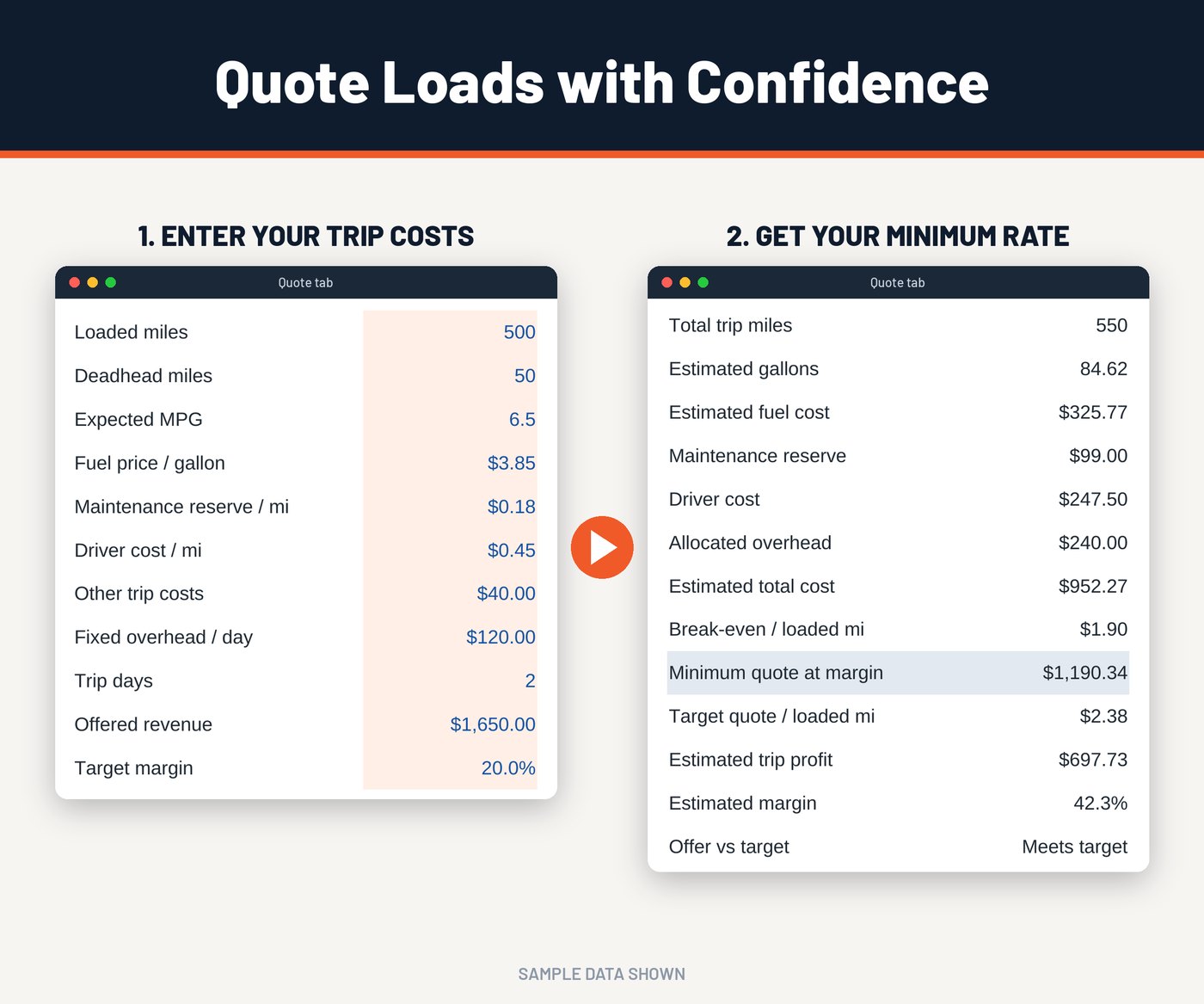
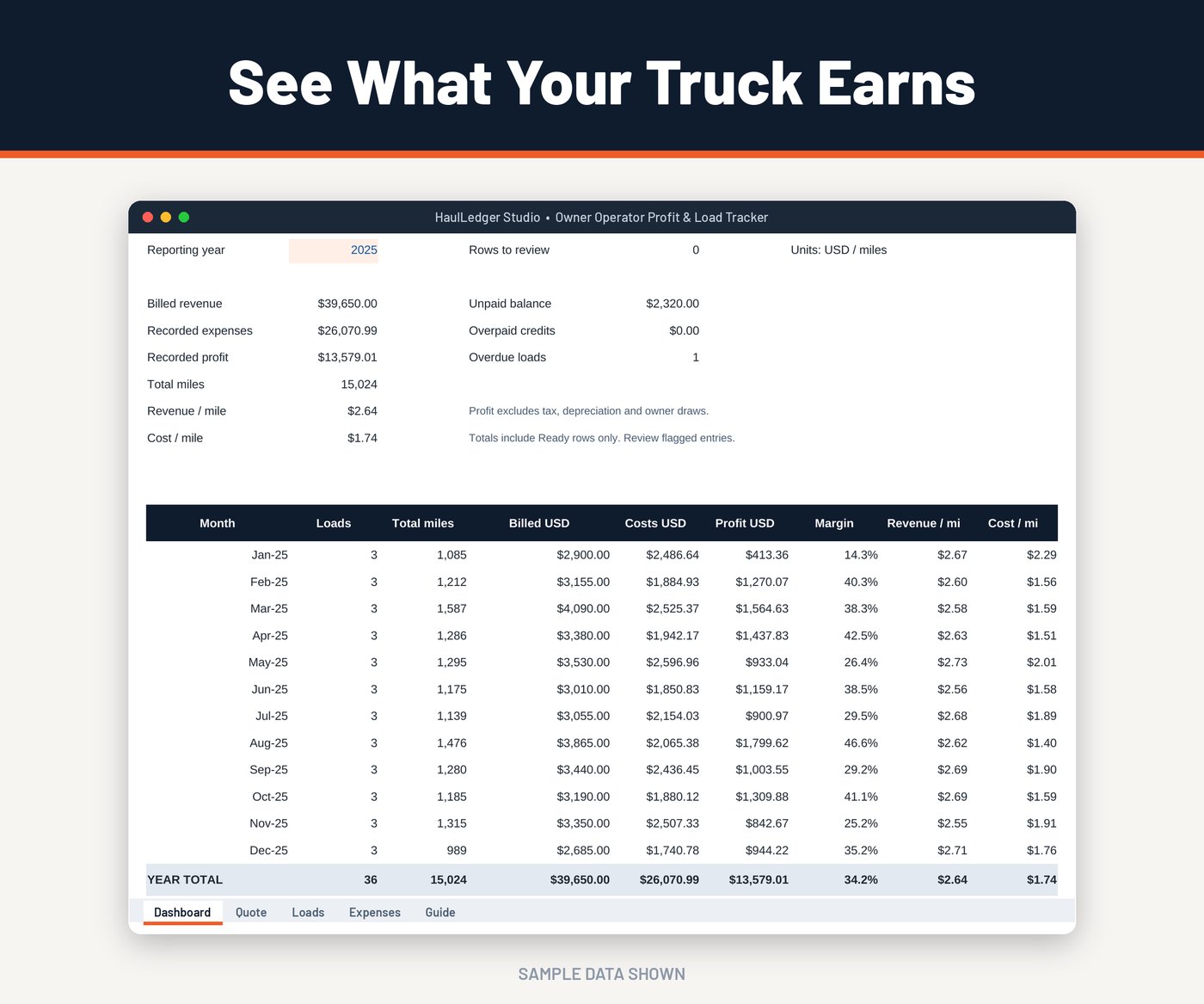
Don’t want to redo this math every month? The HaulLedger Owner-Operator Profit & Load Tracker is an Excel and Google Sheets workbook. You log loads and expenses, and the dashboard works out your cost per mile, revenue per mile and profit by month. The Quote tab turns trip costs into a minimum rate. Or grab a notepad and use the steps above.
From trucking cost per mile to the rate you should accept
Your cost per loaded mile is your break-even. To actually make a profit, add a margin:
Minimum rate = cost per loaded mile ÷ (1 − target margin)
With a 15% target margin: $2.11 ÷ 0.85 = about $2.49 per loaded mile.
Run each load through it too. A load’s real rate is the pay divided by all the miles it takes, including the deadhead to pick it up. A $1,500 load with 500 loaded miles looks like $3.00 a mile, but with 150 deadhead miles to get there it’s $1,500 ÷ 650 = $2.31 per mile.
How your trucking cost per mile compares (ATRI 2026 data)
The American Transportation Research Institute (ATRI) publishes the industry’s best-known cost benchmark. In its 2026 update, the average cost to run a truck in 2025 was a record $2.336 per mile. Here’s how it breaks down:
| ATRI cost line (2025) | Per mile |
|---|---|
| Driver wages | $0.818 |
| Fuel | $0.482 |
| Truck/trailer lease or purchase payments | $0.404 |
| Repair and maintenance | $0.215 |
| Driver benefits | $0.210 |
| Truck insurance premiums | $0.106 |
| Tires | $0.050 |
| Tolls | $0.043 |
| Permits and licenses | $0.008 |
| Total | $2.336 |
A few things to keep in mind:
- These are averages from mostly fleet carriers. Your number will be different, and that’s normal.
- ATRI’s figure leaves out overhead like office staff, real estate and software, so your all-in cost per mile can run higher.
- ATRI found fleets averaged about 7.4 mpg and 16.5% empty miles in 2025. If your mpg is lower or your deadhead is higher, expect a higher cost per mile.
Ways to lower your trucking cost per mile
- Cut deadhead. Plan your next load before you deliver, and look at the rate on all miles, not just loaded.
- Watch your speed and idle time. Fuel is one of your biggest variable costs.
- Do preventive maintenance. A scheduled repair costs less than a breakdown plus a tow plus a missed load.
- Shop your insurance every renewal. Get quotes from more than one agent.
- Run more miles on the same fixed costs. Your truck payment is the same whether you run 6,000 or 10,000 miles, so every extra paid mile lowers your cost per mile.
Free: Know Your Number cost-per-mile calculator. See your break-even rate before you book a load.
Trucking cost per mile FAQ
What’s a good cost per mile for an owner-operator? There’s no single right number. It depends on your truck, freight, lanes and how many miles you run. ATRI’s 2025 industry average was $2.336, but what matters is that your rate stays above your cost per loaded mile.
Should I include deadhead miles? Yes, in your total-miles cost per mile. Then also figure your cost per loaded mile, since that’s what you get paid on.
How often should I recalculate it? Every month. Fuel prices, insurance and repairs change, and so does your cost per mile.
Is per diem part of my cost per mile? Per diem is a tax deduction, not money you spend, so leave it out of your cost per mile. Count the actual meals and lodging you pay for if you want them in there, and ask your tax preparer how per diem applies to you.
Does this work for box trucks and hotshots? Yes. Same formula, different numbers. Smaller trucks usually have lower fuel and payment costs but also get lower rates.
Know your trucking cost per mile before the next load
Once you know your cost per mile, you stop guessing on rates. If you want a spreadsheet that does the math for you, the Owner-Operator Profit & Load Tracker tracks every load and expense and shows your cost per mile and profit month by month in Excel or Google Sheets.
Not tax or financial advice. The example uses made-up numbers. Your costs, rates and tax situation are your own, so check with a tax professional for deductions like per diem and depreciation.
Sources (checked October 2026)
- ATRI, Analysis of the Operational Costs of Trucking: 2026 Update (Table 8, average marginal costs per mile; fuel economy and empty miles), released July 15, 2026
- IRS, About Form 2290 (heavy vehicle use tax)
- UCR, Fee brackets; IFTA, Carriers