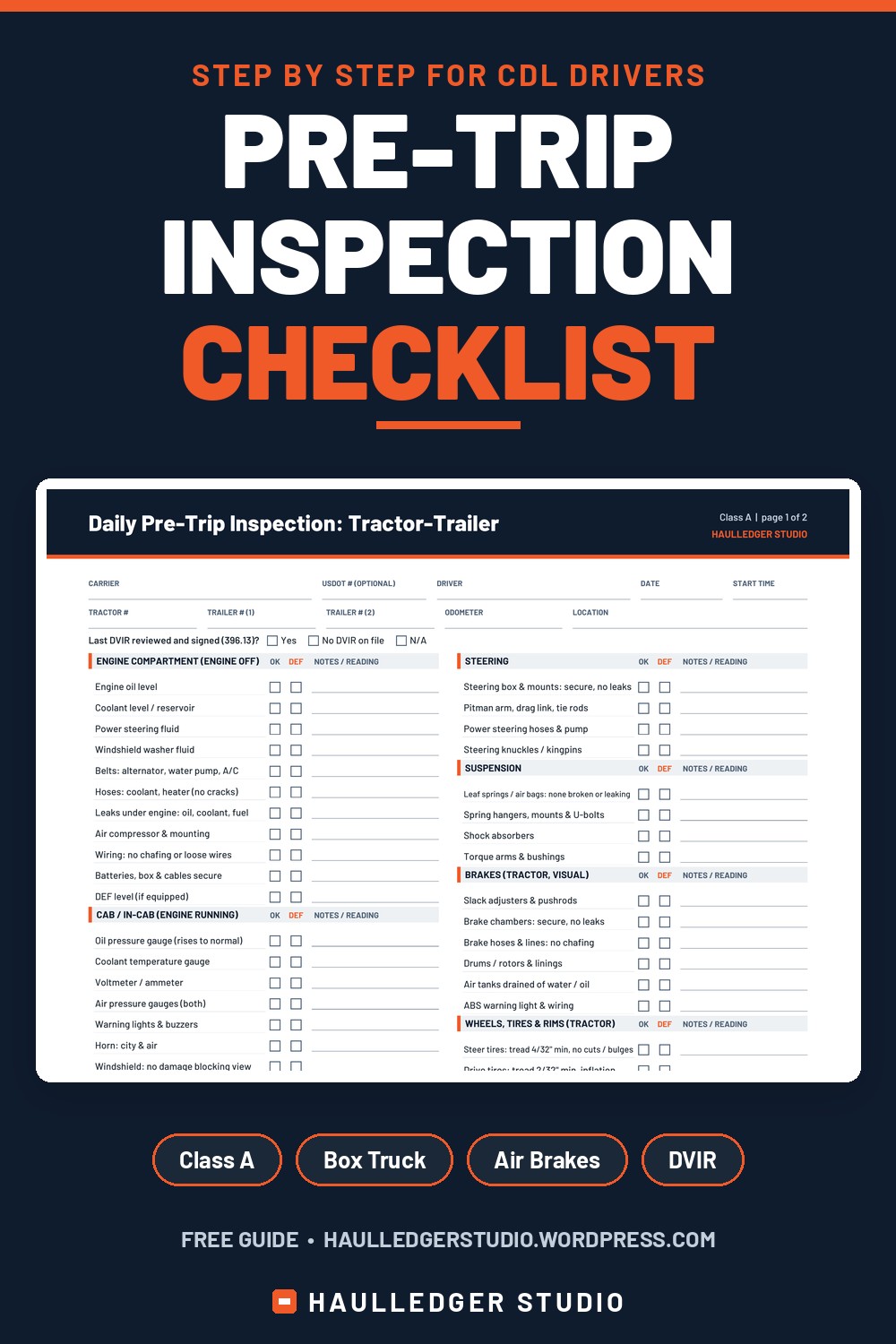
A good pre-trip inspection checklist keeps you out of the shop, off the side of the road and out of trouble at a roadside inspection. This step-by-step pre-trip inspection checklist walks a CDL driver around a tractor-trailer the same way every time, explains what the federal rules actually require, and covers the end-of-day DVIR too. Box truck drivers, there’s a section for you near the end.
New carrier? Run the free DOT check and see your compliance gaps in 2 minutes.
What the rules say about your pre-trip inspection checklist
Here’s the plain-English version of the federal rules (49 CFR, the Federal Motor Carrier Safety Regulations):
- Before you drive (§396.13): you have to be satisfied the vehicle is in safe operating condition. If the last driver vehicle inspection report (DVIR) listed defects, you review it and sign it to show the repairs were certified.
- The parts that must work (§392.7): service brakes (including trailer brake connections), parking brake, steering, lights and reflectors, tires, horn, wipers, mirrors, coupling devices, wheels and rims, and emergency equipment.
- Emergency equipment (§392.8 and §393.95): a charged, mounted fire extinguisher and three reflective warning triangles. Spare fuses are no longer a federal requirement. That rule was removed effective April 20, 2026.
- Pre-trip time counts (§395.2): time spent inspecting your truck is on-duty time. Log it.
There’s no federal rule that says your pre-trip has to be written down. The written report the rules require is the DVIR at the end of the day (more on that below). A written checklist is still the easiest way to make sure you don’t skip something, and to prove you did it.
Free: Know Your Number cost-per-mile calculator. See your break-even rate before you book a load.
Step-by-step pre-trip inspection checklist (Class A tractor-trailer)
Work the same order every day so nothing gets missed.
1. Review and approach – ☐ Read the last DVIR. If it lists defects, check that repairs were certified, then sign it. – ☐ Look at the rig as you walk up: leaning, fresh puddles under the engine, damage.
2. Engine compartment (engine off) – ☐ Oil, coolant, power steering and washer fluid levels – ☐ Belts (alternator, water pump, A/C) and hoses: no cracks or fraying – ☐ Leaks: oil, coolant, fuel – ☐ Air compressor, wiring and battery secure – ☐ Steering box, linkage and hoses: secure, no leaks
3. In the cab (engine running) – ☐ Oil pressure and coolant temperature gauges come up to normal – ☐ Air pressure builds normally, and warning lights and buzzers work – ☐ Horn, wipers, washers, heater and defroster – ☐ Mirrors clean and adjusted, windshield clear – ☐ Seat belt – ☐ Fire extinguisher charged and mounted; 3 reflective triangles on board – ☐ Registration, insurance and permits in the truck
4. Lights – ☐ Headlights (low and high), turn signals, 4-way flashers – ☐ Clearance, marker and ID lights; brake and tail lights; reflective tape
5. Walkaround: tractor – ☐ Suspension: springs, air bags, hangers, U-bolts – ☐ Brakes: slack adjusters, chambers, hoses, drums or rotors – ☐ Tires: at least 4/32″ tread on steer tires and 2/32″ on all others (§393.75), proper inflation, no cuts or bulges, duals not touching – ☐ Rims and lug nuts: no cracks, nothing loose or missing, no rust trails – ☐ Frame, exhaust, fuel tanks and caps
6. Coupling – ☐ Fifth wheel mounted and greased; locking jaws closed around the kingpin; release arm locked – ☐ No gap between the trailer apron and fifth wheel – ☐ Air lines and electrical cord: connected, no leaks, not dragging
7. Trailer – ☐ Doors, hinges and seals; cargo secured – ☐ Landing gear fully up, crank handle stowed – ☐ Trailer tires, wheels, brakes, suspension and lights (same checks as the tractor)
8. In-cab air brake check State CDL manuals use benchmarks like these. Your truck maker’s specs come first. – ☐ Low-air warning comes on before pressure drops below 55 to 60 psi (the number varies by state manual and truck maker) – ☐ Applied leakage: no more than 4 psi in one minute for a two-unit combination – ☐ Spring brakes pop out at about 20 to 45 psi as you fan down the air – ☐ Parking brake and service brake test: the truck holds, then stops straight
9. Sign off – ☐ Note anything you found. Don’t drive with a defect that affects safe operation.
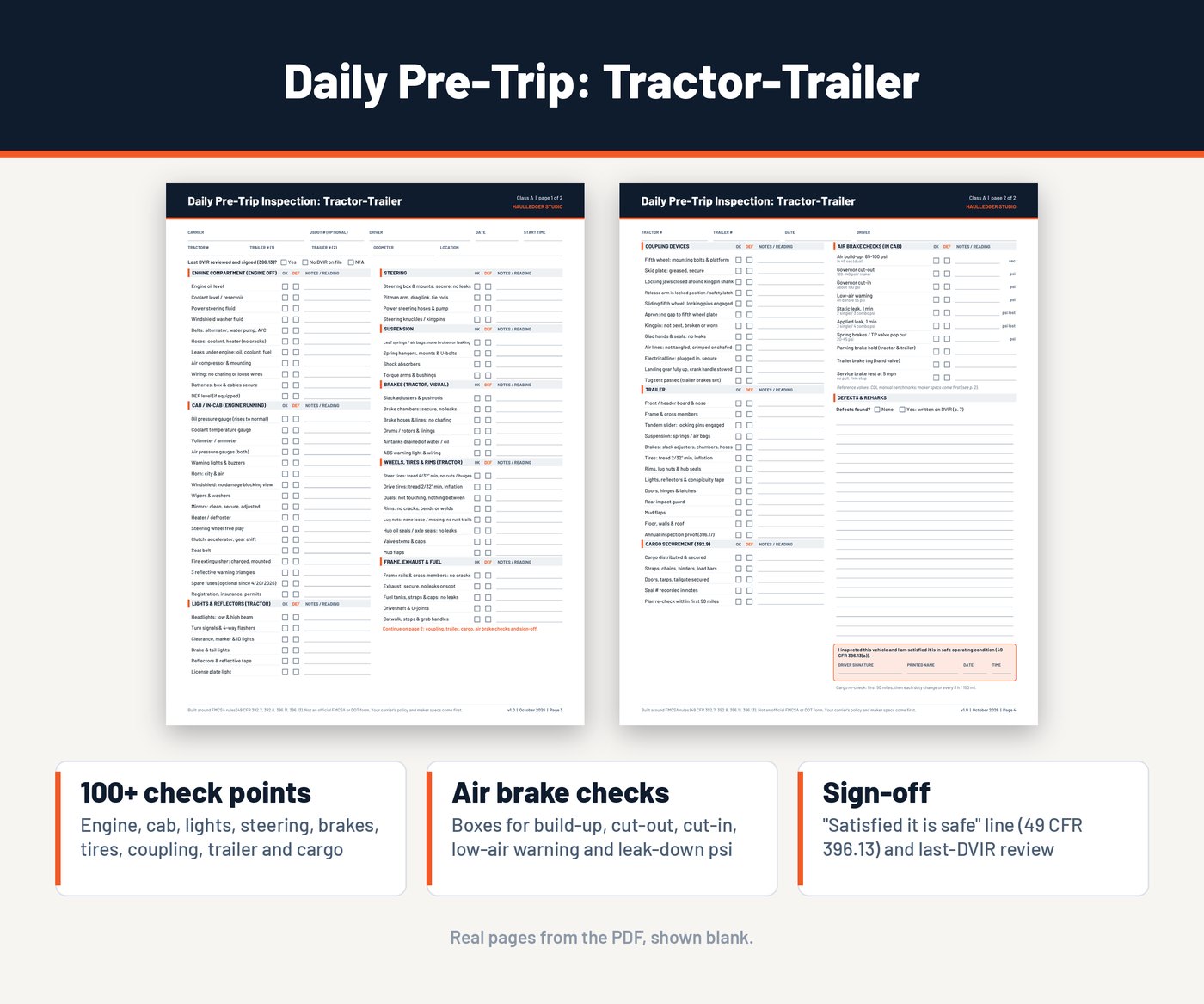
Tired of a crumpled checklist in the door pocket? The HaulLedger Pre-Trip & Post-Trip Inspection Forms turn this checklist into a printable, fillable PDF with Class A, box truck and trailer pages, a DVIR and a monthly log. Or just use the list above.
Box truck pre-trip inspection checklist
Same idea, fewer parts. On a box truck, skip coupling and add:
- ☐ Hydraulic brakes: pump the pedal 3 times, then hold firm pressure for 5 seconds. The pedal shouldn’t sink.
- ☐ Cargo box: roll-up door, latches, floor and walls
- ☐ Liftgate: controls, chains or cables, hydraulic leaks, and that it stows and locks
- ☐ Rear impact guard (ICC bar) secure
Post-trip and the DVIR: finishing your pre-trip inspection checklist
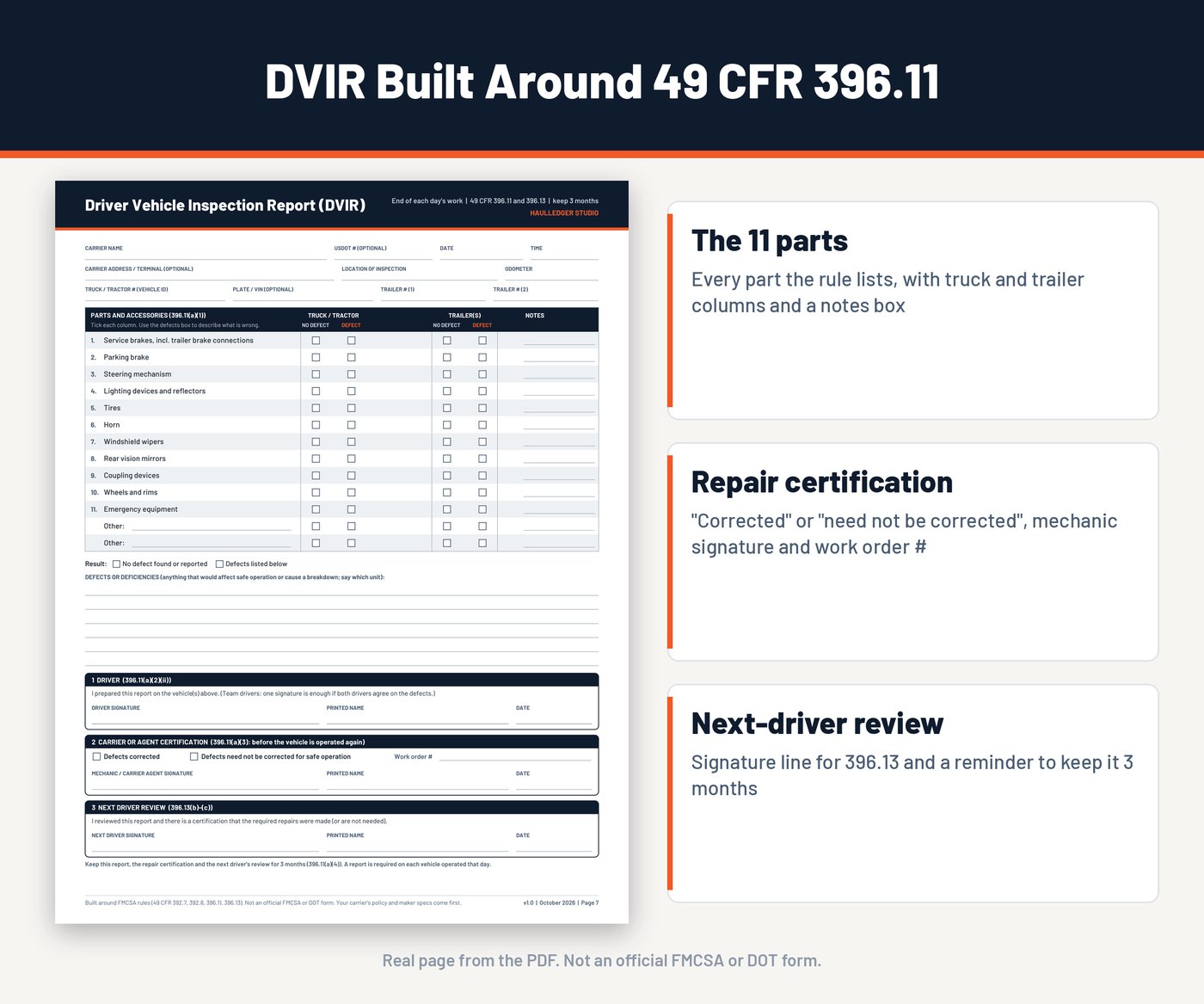
The DVIR is the federal “post-trip” paperwork (§396.11):
- At the end of each day’s work, you write a report on each vehicle you drove, covering the same 11 parts from §392.7.
- If you found no defect and none was reported to you, the federal rule doesn’t require a written report. Your carrier may still require one.
- If there’s a defect, the carrier has to fix it (or certify it doesn’t need fixing) before the truck runs again.
- The carrier keeps the DVIR, the repair certification and the next driver’s review for 3 months.
- Electronic DVIRs are allowed.
One-truck owner-operators: §396.11 doesn’t apply to a carrier running only one commercial motor vehicle. You still can’t drive an unsafe truck (§392.7 and §396.7), so doing the walkaround is still a smart habit.
CDL test pre-trip vs. your daily pre-trip inspection checklist
The CDL skills test pre-trip is its own thing. Examiners usually want you to point to each part and say out loud what you’re checking for, in the order your state’s CDL manual teaches. Study your state’s manual for the test. The checklist above is for real-world daily use.
Free: Know Your Number cost-per-mile calculator. See your break-even rate before you book a load.
Pre-trip inspection checklist FAQ
How long should a pre-trip inspection take? No federal rule sets a minimum time. Take as long as it takes to check everything, and log it as on-duty time.
Do I have to fill out a written pre-trip form? Not under federal rules. The written report the rules require is the DVIR when a defect is found or reported. Many carriers require a written pre-trip by company policy.
Are spare fuses still required? Not federally. FMCSA removed the spare fuse requirement from §393.95, effective April 20, 2026. Your carrier or state may still want them.
What’s the minimum tread depth? At least 4/32″ on steer tires and 2/32″ on all other tires (§393.75).
How long do I keep DVIRs? The carrier keeps them for 3 months from the date the report was prepared.
Make your pre-trip inspection checklist a habit
A pre-trip only works if you do it the same way every day. If you want a clean form for every shift, the Pre-Trip & Post-Trip Inspection Forms give you a fillable PDF for your phone or tablet, or printable pages for a clipboard. Pair it with the list above and you’re set.
Not legal advice. This is a plain-English summary of federal rules current as of October 2026. Your carrier’s policy, your state and your truck maker’s specs can add requirements. The HaulLedger forms are not official FMCSA or DOT forms.
Sources (checked October 2026)
- eCFR, 49 CFR 392.7, 392.8, 393.75, 393.95, 395.2, 396.7, 396.11, 396.13
- Federal Register, 91 FR 7877 (spare fuses, Feb. 19, 2026) and 79 FR 75437 (no-defect DVIRs, Dec. 18, 2014)
- California DMV, California Commercial Driver Handbook, Section 5 (air brakes)