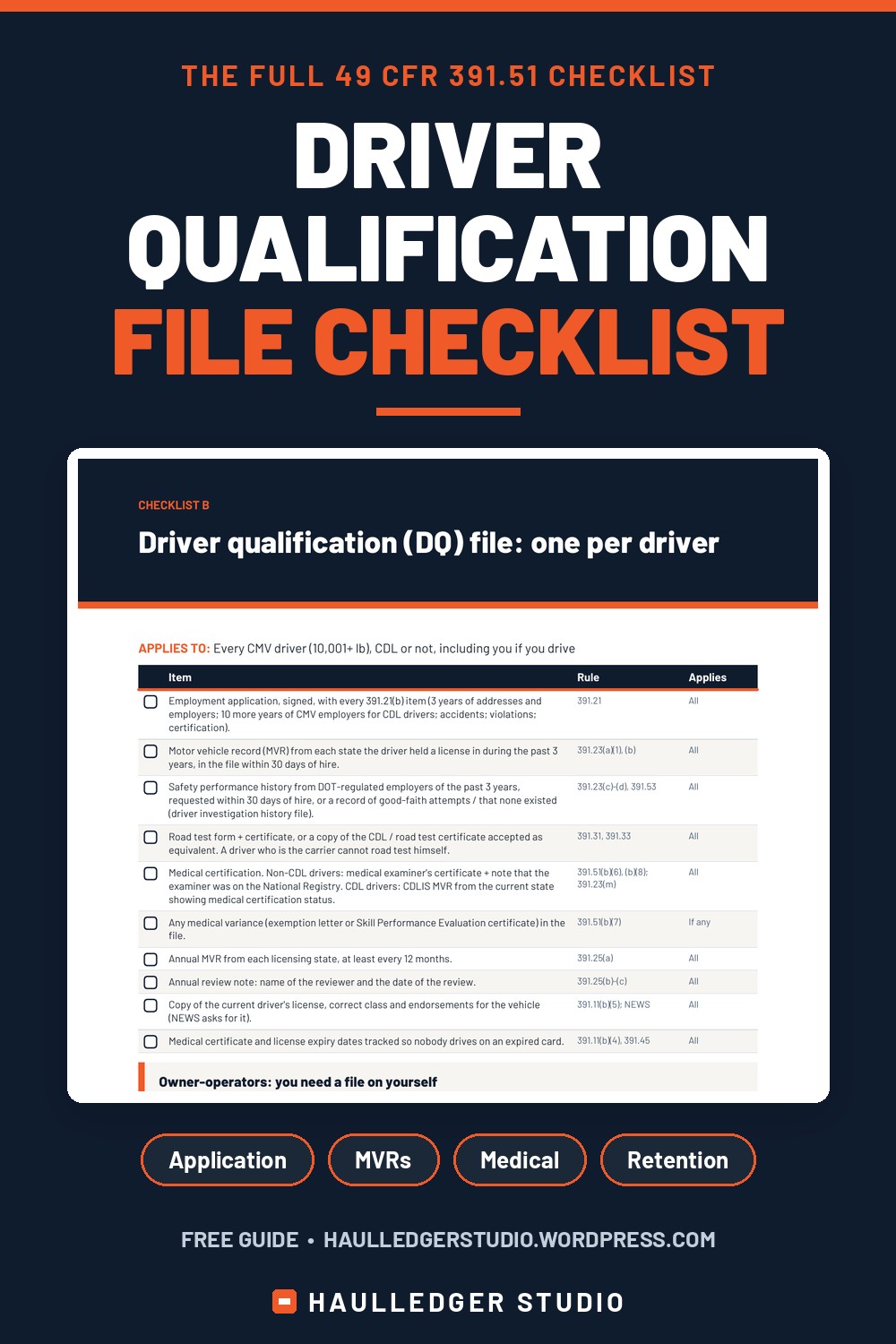
A driver qualification file (DQ file) is the folder FMCSA expects you to keep on every driver who runs a commercial motor vehicle for your company, and that includes you if you’re an owner-operator with your own authority. It’s one of the first things checked at a new entrant safety audit. Below is the full driver qualification file checklist from 49 CFR 391.51, in plain English, with what goes in, when, and how long to keep it.
New carrier? Run the free DOT check and see your compliance gaps in 2 minutes.
Who needs a driver qualification file?
Under Part 391, every motor carrier has to keep a driver qualification file for each driver it employs (§391.51(a)). That covers interstate drivers of commercial motor vehicles of 10,001 pounds or more, CDL or not. “Employs” includes independent contractors driving for you.
Owner-operators: you need a DQ file on yourself. If you’re both the motor carrier and the driver, you have to follow the carrier rules and the driver rules (§391.1(b)). One catch: you can’t give yourself your own road test. A carrier-driver has to be tested by someone else (§391.31(b)), or you can accept your valid CDL as the equivalent (§391.33).
Free: Know Your Number cost-per-mile calculator. See your break-even rate before you book a load.
The driver qualification file checklist (49 CFR 391.51)
Here’s what §391.51(b) says has to be in each file:
- ☐ Employment application (§391.21). It has to be signed and include 3 years of addresses, every unexpired license, driving experience, accidents and violations from the past 3 years, any license suspensions, and employers from the past 3 years. CDL drivers also list CMV employers for the 7 years before that, 10 years total.
- ☐ Pre-hire motor vehicle record (MVR) from every state where the driver held a license or permit in the past 3 years. Request it within 30 days of hire (§391.23(a)(1), (b)).
- ☐ Road test certificate (§391.31(e)), or a copy of the CDL or certificate you accepted as equivalent (§391.33).
- ☐ Annual MVR from each licensing state, pulled at least once every 12 months (§391.25(a)).
- ☐ Annual review note with the name of the person who reviewed the driving record and the date (§391.25(c)(2)).
- ☐ Medical certification: – CDL drivers: the CDLIS MVR from the current licensing state showing medical certification status (§391.51(b)(6)(ii)). Since June 23, 2025, medical examiners send DOT physical results to FMCSA’s National Registry, which passes them to the state. In states that have made the switch, the paper medical card no longer proves certification for CDL drivers, so pull the MVR. If your state hasn’t switched yet, FMCSA says to keep using the paper certificate process until it does. – Non-CDL drivers: the medical examiner’s certificate (or a legible copy), plus a note that you verified the examiner is on FMCSA’s National Registry (§391.51(b)(8)(i), §391.23(m)(1)).
- ☐ Medical variance documents, if any: a Skill Performance Evaluation certificate or a federal medical exemption (§391.51(b)(7)).
Keep separately, but have ready: – ☐ Safety performance history from DOT-regulated employers of the past 3 years, requested within 30 days of hire. This goes in a separate, secure driver investigation history file (§391.23(c), §391.53). – ☐ Clearinghouse queries (CDL drivers): a full pre-employment query before the driver runs, then at least one query a year. Keep a record of each query for 3 years (§382.701).
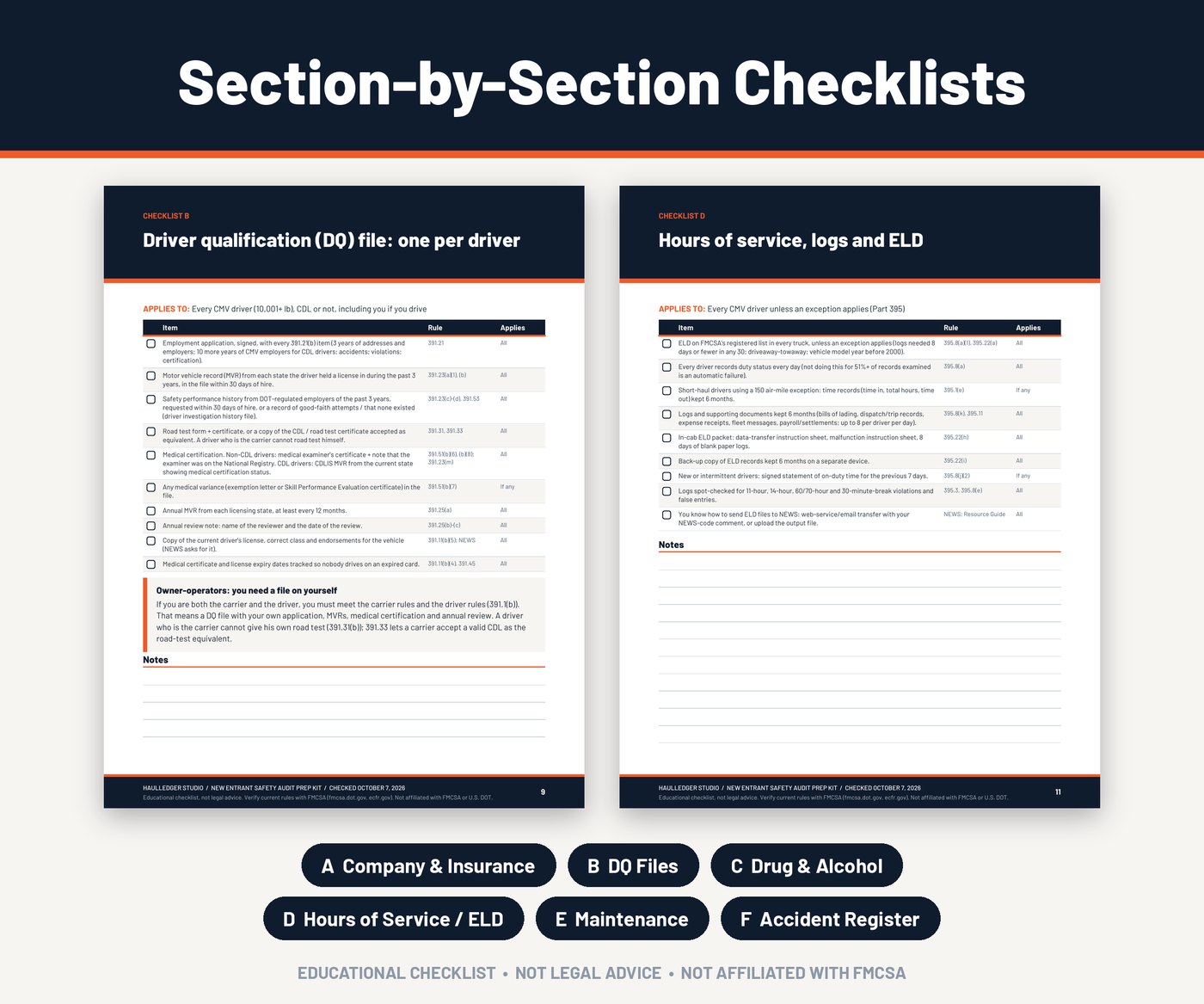
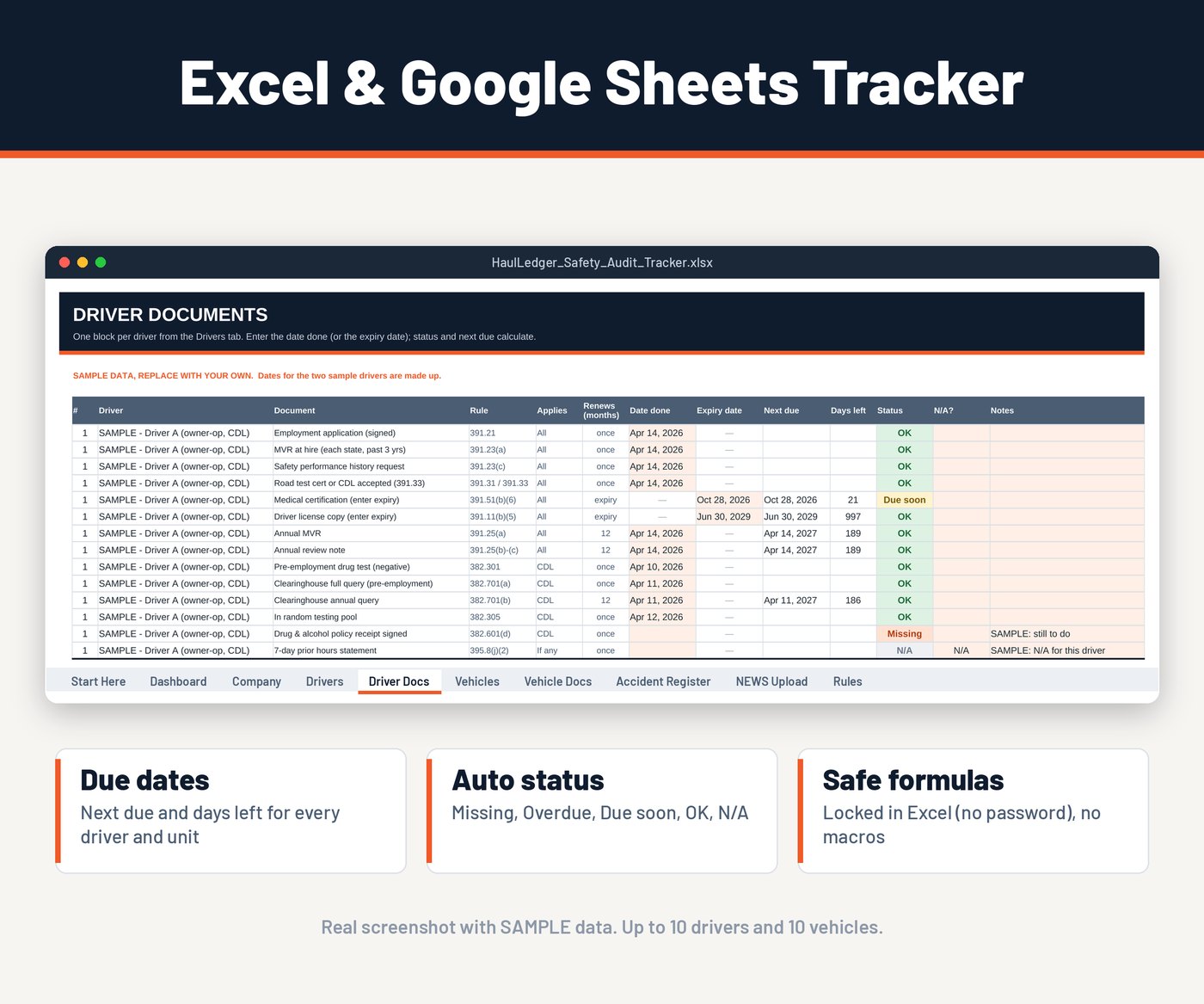
Want this as a printable checklist plus a tracker? The HaulLedger New Entrant Safety Audit Prep Kit has a per-driver DQ file checklist with the rule next to every item, and an Excel / Google Sheets tracker that flags expiring medical cards and overdue annual MVRs. The list above works fine on its own too.
How long to keep a driver qualification file
- The whole file: as long as the driver works for you, plus 3 years after they leave (§391.51(c)).
- Items you may remove 3 years after they’re dated: annual MVRs, annual review notes, medical certificates or CDLIS MVRs, medical variances, and National Registry verification notes (§391.51(d)).
- Driver investigation history: for as long as the driver is employed plus 3 years (§391.53).
Driver qualification file deadlines at a glance
| What | When |
|---|---|
| Application signed | Before the driver drives |
| Pre-hire MVR (3 years, every state) | Within 30 days of hire |
| Safety performance history request | Within 30 days of hire |
| Road test or equivalent | Before the driver drives |
| Medical certification verified | Before the driver drives |
| Clearinghouse pre-employment query | Before the driver drives (CDL) |
| Annual MVR + review note | At least every 12 months |
| Medical card | Before it expires (up to 24 months) |
Driver qualification file mistakes that fail audits
At a new entrant safety audit, knowingly using a disqualified driver, a driver without a valid CDL, or a medically unqualified driver is an automatic failure. That’s straight from FMCSA’s New Entrant Safety Assurance page. The paperwork mistakes that lead there:
- An expired medical card nobody noticed
- No annual MVR, or an MVR with no review note
- A missing pre-hire MVR from a state the driver lived in
- An owner-operator with no file on themselves at all
New carriers have plenty more to set up than the DQ file. The trucking business plan guide lists the rest, and your daily inspections are covered in the pre-trip inspection checklist.
Free: Know Your Number cost-per-mile calculator. See your break-even rate before you book a load.
Driver qualification file FAQ
What is required in a driver qualification file? The signed application, a pre-hire MVR from every state for the past 3 years, a road test certificate or equivalent, annual MVRs and review notes, medical certification, and any medical variance (49 CFR 391.51(b)).
Do owner-operators need a driver qualification file? Yes, if you have your own authority. You’re both the carrier and the driver, so the rules for both apply (§391.1(b)).
How long do you keep a driver qualification file? As long as the driver is employed plus 3 years. Some items, like annual MVRs and old medical certificates, can be removed 3 years after they’re dated.
How often do I need to pull an MVR? At least once every 12 months, from every state where the driver held a CMV license or permit in that time, and review it.
Is the drug test result part of the DQ file? No. Drug and alcohol testing records are kept under Part 382, separate from the DQ file. Keep them confidential.
Does a non-CDL driver need a DQ file? Yes. Part 391 covers interstate drivers of commercial motor vehicles of 10,001 pounds or more, with or without a CDL.
Can a DQ file be electronic? FMCSA allows electronic records as long as they meet its electronic recordkeeping rules (49 CFR 390.32) and you can produce them when asked.
Get your driver qualification file audit-ready
Print the checklist, build a folder for every driver (including yourself), and put the annual MVR and medical card dates on your calendar. For the whole safety audit plus the business setup, the New Authority Trucking Bundle combines the Safety Audit Prep Kit with the startup kit, profit tracker and IFTA tracker in one download.
Not legal advice. This is a plain-English summary of 49 CFR Part 391 as published on eCFR in October 2026. Rules change, so check ecfr.gov and fmcsa.dot.gov, and talk to a compliance professional if you’re unsure. HaulLedger Studio isn’t affiliated with FMCSA or the U.S. DOT.
Sources (checked October 2026)
- eCFR (current to Oct. 7, 2026), 49 CFR 391.1, 391.21, 391.23, 391.25, 391.31, 391.33, 391.45, 391.51, 391.53, 382.701, 390.32
- FMCSA, New Entrant Safety Assurance Program
- FMCSA, Digital medical certification (NRII) launch, June 23, 2025 and guidance for states not yet on NRII