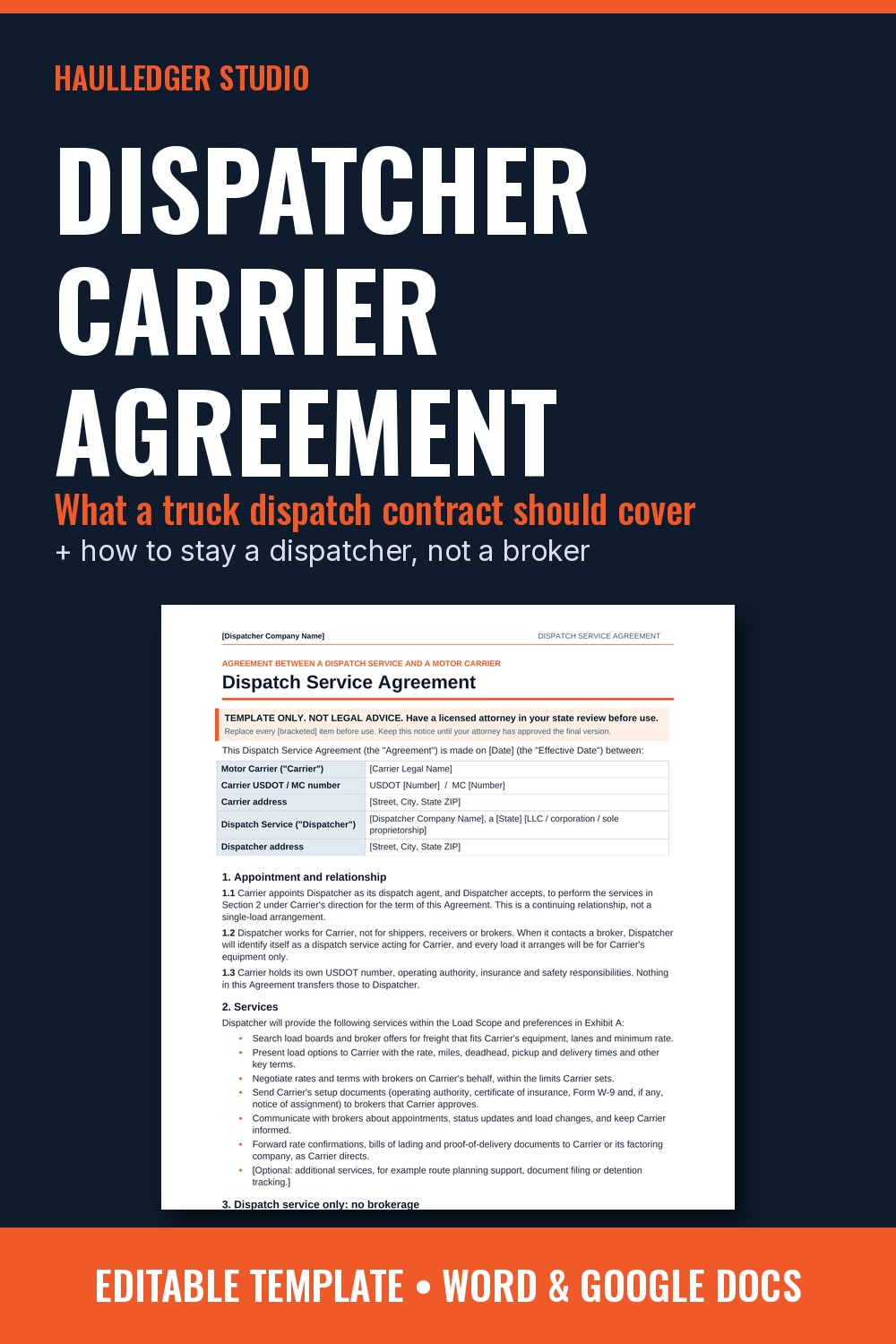
A dispatcher carrier agreement is the written contract between a truck dispatch service and the motor carrier it books loads for. If you’re learning how to start a dispatch business, it’s the first document you need, and it does more than set your fee. FMCSA’s 2023 guidance on brokers says a written agreement with each carrier is one of the signs that you’re a dispatch service and not an unlicensed broker. This guide covers what a carrier dispatch agreement should include, the clauses that keep you on the dispatcher side of the line, and how to onboard a new carrier.
New carrier? Run the free DOT check and see your compliance gaps in 2 minutes.
Why a dispatcher carrier agreement matters
On June 16, 2023, FMCSA published final guidance called Definitions of Broker and Bona Fide Agents (Federal Register Doc. 2023-13080). It has a section on dispatch services. The key points:
- A dispatch service is not automatically a broker, and not automatically exempt. It depends on what the business actually does.
- The guidance isn’t a regulation, but it explains how FMCSA reads the law. Acting as a broker without broker authority can bring civil penalties under 49 U.S.C. 14916.
- A dispatcher that works only for carriers that have appointed it as their agent can fit the “bona fide agent” idea in 49 CFR 371.2, which is outside the broker definition.
So your truck dispatcher contract is your paper trail. It shows who you work for, who pays you, and what you’re allowed to do.
Free: Know Your Number cost-per-mile calculator. Help your carriers see their break-even rate before you book a load.
Dispatch service vs. broker: the signs FMCSA lists
The 2023 guidance lists factors that point each way.
Signs of a dispatch service (no broker authority needed):
- A written agreement with each carrier appointing the dispatcher as its agent, including who is responsible for insurance and liability.
- It complies with any state licensing requirements.
- It works through brokers and doesn’t solicit shippers.
- It’s paid only by the carrier, never by brokers, 3PLs or factoring companies, and it isn’t in the money flow between broker and carrier.
- It tells brokers which carrier it’s dispatching for and doesn’t reassign loads.
Signs of brokering (broker authority needed):
- Negotiating with shippers.
- Taking any payment from a broker or factoring company, or handling the freight money.
- Working without a written agreement with the carrier.
- Accepting a load before having a truck for it, or choosing which of several carriers gets a load.
That last point matters if you dispatch for more than one carrier. FMCSA treats choosing which carrier gets a load as “allocating traffic,” a brokerage activity. The guidance says a dispatch service can serve several carriers if their scopes don’t overlap, for example by geography, commodity or equipment type.
What to include in a dispatcher carrier agreement
A solid carrier dispatch agreement covers these sections:
- Parties and appointment. The carrier’s legal name, USDOT and MC numbers, and a clause appointing you as the carrier’s dispatch agent. State that the carrier keeps its own operating authority, insurance and safety responsibilities.
- Services. Searching load boards, presenting load options, negotiating rates with brokers within limits the carrier sets, sending setup packets and handling paperwork.
- Dispatch service only, no brokerage. You don’t hold yourself out as a broker, don’t solicit shippers, don’t take money from brokers and don’t reassign loads.
- Carrier’s right to refuse. The carrier approves every load and can turn any of them down. Rate confirmations are in the carrier’s name.
- Load scope. Lanes, equipment and freight you’ll book for this carrier. If you serve more than one carrier, keep the scopes from overlapping.
- Fee and payment. Your fee (percentage or flat), when it’s due, and that you bill the carrier only.
- No guarantee of loads or income. Don’t promise a number of loads or a weekly gross.
- Insurance and liability. Who carries what. For-hire carriers of general freight in vehicles of 10,001 lb GVWR or more need at least $750,000 in liability coverage under 49 CFR 387.9.
- Independent contractor, confidentiality, term and termination. How either side can end the agreement and what happens to loads already booked.
- Signatures and exhibits. A Load Scope exhibit and a fee schedule exhibit, signed and dated.
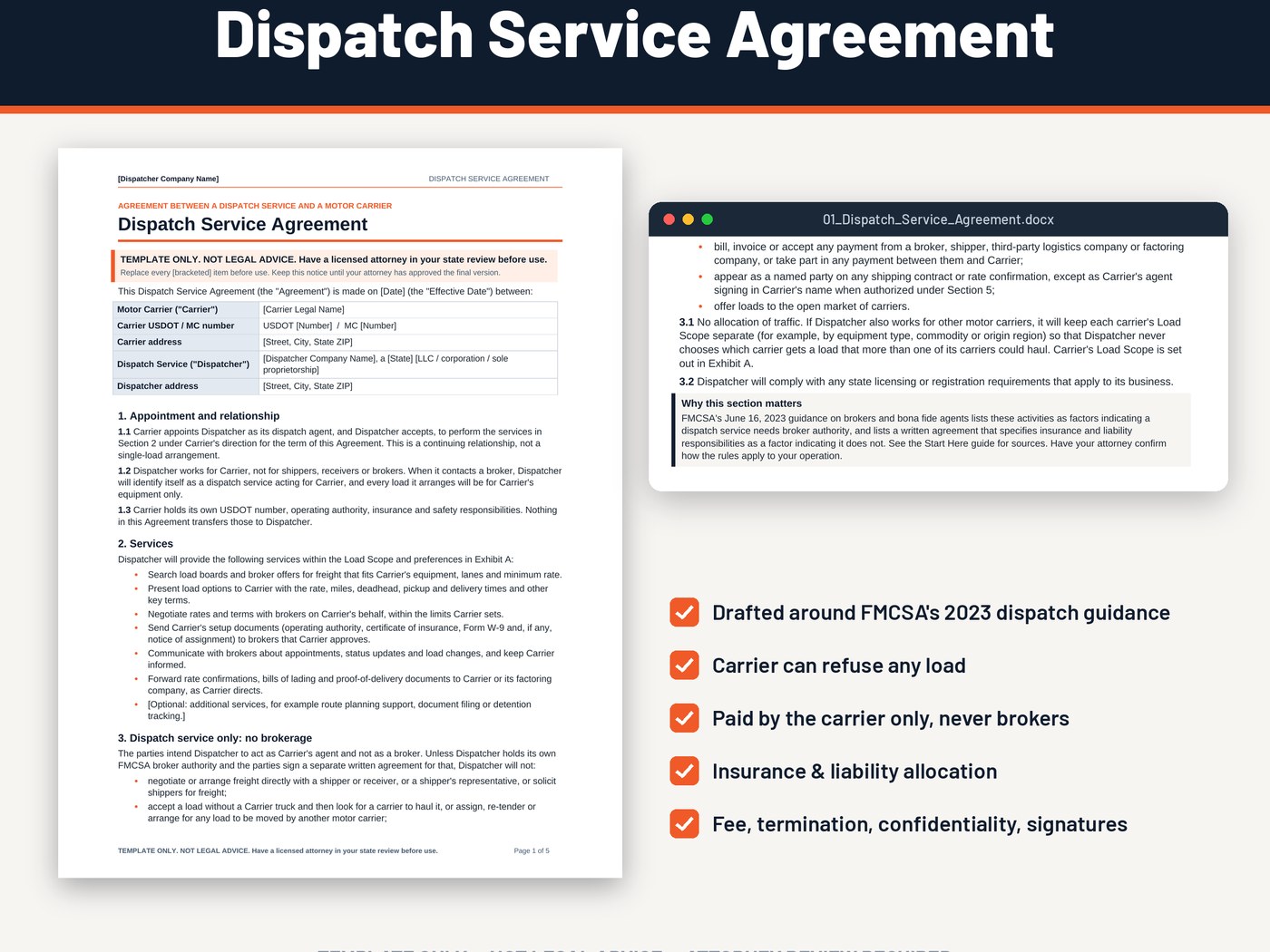
Want the full contract ready to edit? The Dispatcher Carrier Agreement Template & Onboarding Pack has the dispatch service agreement, a limited authorization form, an onboarding checklist, a carrier information sheet and a fee invoice, in Word and Google Docs.
The limited authorization to act
Many brokers want proof that you can sign a rate confirmation for the carrier. A separate, narrow authorization is cleaner than a broad power of attorney. Keep it tight:
- You sign rate confirmations in the carrier’s name only, and only after the carrier approves each load.
- Add a clear list of what you can’t do, such as collecting freight payments or signing loans or leases.
- Put an expiration date on it and a way for the carrier to revoke it in writing.
How to start a dispatch business: onboard each carrier the same way
Before the first load, check the carrier and collect its paperwork. A simple carrier onboarding checklist:
- Authority and USDOT status. Look the carrier up on FMCSA’s SAFER company snapshot and its registration system to confirm active authority and insurance on file.
- BOC-3. FMCSA requires a process agent for each state the carrier operates in or through, and only a process agent can file the form.
- UCR. Confirm the carrier is registered with the Unified Carrier Registration plan for the current year.
- Certificate of insurance. Auto liability and cargo, with expiration dates.
- W-9 and payment details. Plus a notice of assignment if the carrier uses a factoring company.
- Equipment, ELD and drivers. Truck and trailer type, ELD provider and driver contact information. Drivers’ files are the carrier’s job, but our driver qualification file guide shows what they need.
- Signed agreement, authorization and fee terms.
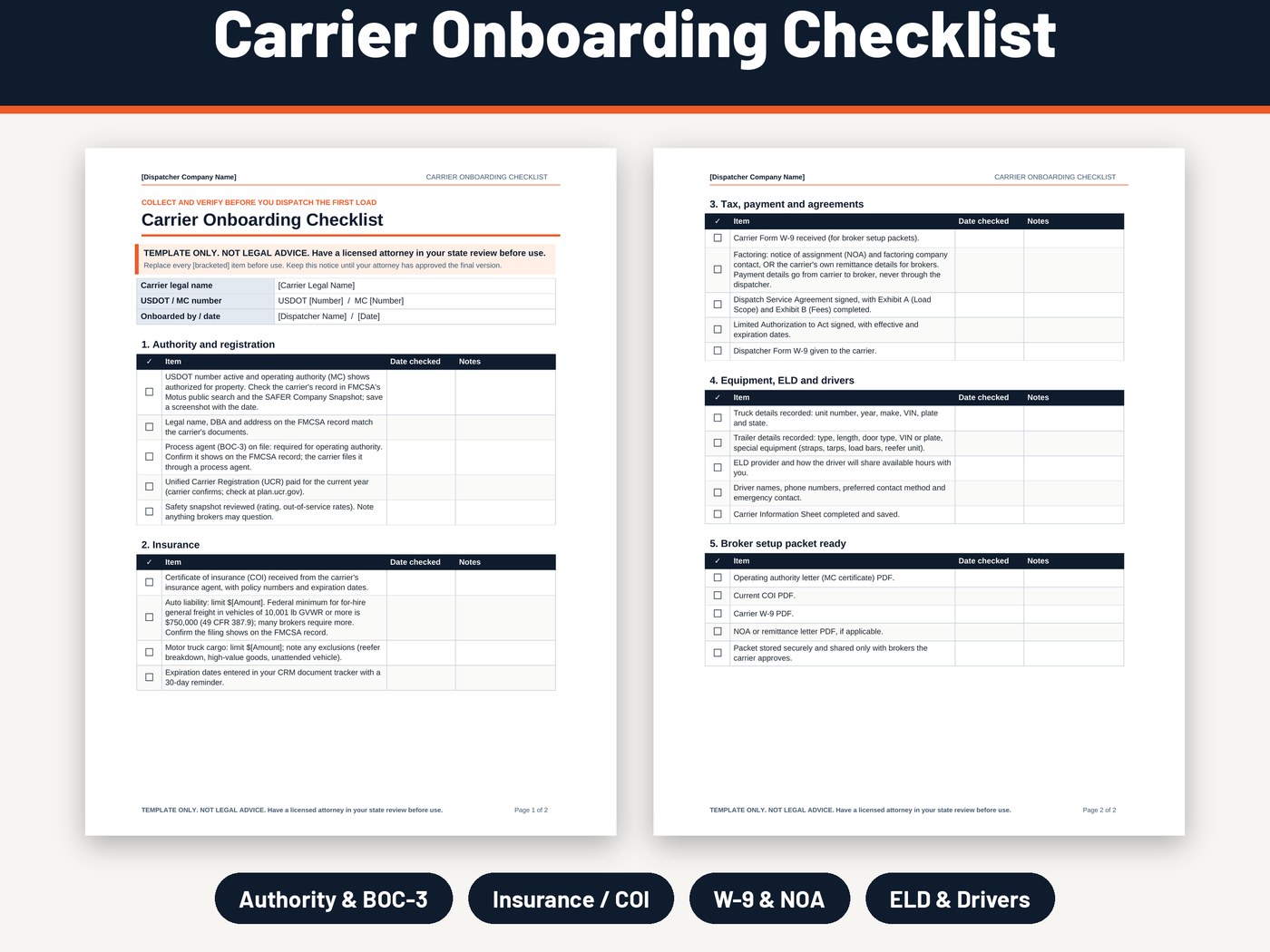
Set reminders for insurance expiration dates and for the authorization’s end date. A lapse in either can stop a load.
Truck dispatcher contract mistakes to avoid
- Billing the broker. Your invoice goes to the carrier. Taking your cut from the broker’s payment puts you in the money flow, which FMCSA lists as a brokering sign.
- Booking a load and then finding a truck. That’s a brokering sign. Get the carrier’s approval first.
- Overlapping scopes. Two carriers running the same lanes with the same equipment means you’ll end up choosing between them.
- Promising income. “Guaranteed $X a week” in a contract or ad is a fast route to a dispute.
- Skipping state rules. Some states have their own registration or licensing rules for businesses. Check yours.
New carriers you dispatch for also need to know their numbers. Share our trucking cost per mile guide so they can set a minimum rate, and if you’re writing a plan for your own dispatch company, the trucking business plan guide walks through the sections.
Free: Know Your Number cost-per-mile calculator. A clear minimum rate makes every rate negotiation easier.
Dispatcher carrier agreement FAQ
Do I need an MC number to be a truck dispatcher? Not if you truly work as a dispatch service: appointed by the carrier in writing, paid only by the carrier and not allocating loads, per FMCSA’s 2023 guidance. If you act like a broker, you need broker authority.
Can a dispatcher get paid by the broker? FMCSA lists taking payment from a broker or factoring company as a sign of brokering. Bill the carrier.
Can I dispatch for more than one carrier? Yes, if each carrier’s scope doesn’t overlap with the others by lane, commodity or equipment, so you’re never choosing which carrier gets a load.
What’s the difference between a dispatch agreement and a carrier packet? The dispatch agreement is between you and your carrier. A carrier packet (or broker setup packet) is what a broker sends the carrier to set it up for a load.
Is a template enough? A template is a starting point. Have a licensed attorney in your state review it before you sign carriers.
Get your dispatcher carrier agreement in place
Sign a written agreement with every carrier, bill only the carrier, keep scopes separate and onboard everyone with the same checklist. The Dispatcher Carrier Agreement Template & Onboarding Pack gives you all five documents ready to edit, plus a Start Here guide with links to the official sources.
Not legal advice. This article is general information about FMCSA guidance, and rules can change and vary by state. Have a licensed attorney in your state review any contract before you use it, and verify current requirements with FMCSA.
Sources (checked October 2026)
- FMCSA, Definitions of Broker and Bona Fide Agents, final guidance, Federal Register Doc. 2023-13080 (June 16, 2023), sections on dispatch services; FMCSA page
- eCFR, 49 CFR 371.2 (broker and bona fide agent definitions) and 387.9 (minimum financial responsibility)
- FMCSA, Form BOC-3 and Registration; SAFER Company Snapshot
- UCR Plan, plan.ucr.gov
- 49 U.S.C. 14916 (unlawful brokerage activities)