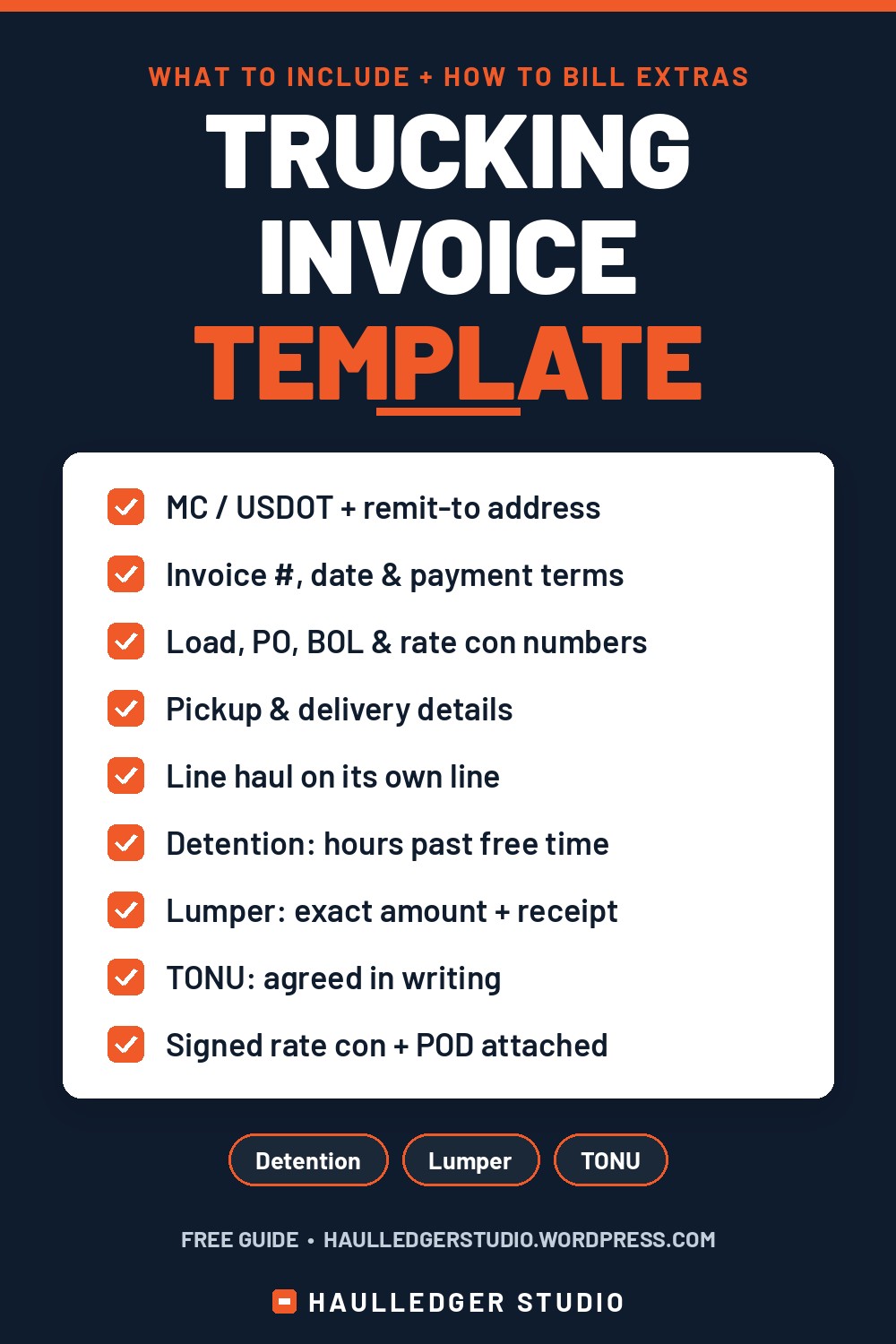
A clean trucking invoice template gets you paid faster and with fewer short-pays. Brokers and shippers pay from paperwork, and an invoice that’s missing a load number, a signed POD or the receipt for a lumper fee usually sits in a pile. This guide covers every line your trucking invoice template should have, how to bill detention, lumper and TONU charges, a sample invoice, and how to follow up when payment is late.
New carrier? Run the free DOT check and see your compliance gaps in 2 minutes.
What to include on a trucking invoice template
Federal rules list what a for-hire motor carrier’s freight bill should show (49 CFR 373.103(a)): the shipper and consignee, the shipment date, origin and destination, the number of packages, a description of the freight, the weight if it affects the rate, the exact rates, total charges including any special-service charges and where they happened, the route and carriers involved, and where to send payment. Build your trucking invoice template around that list, plus what brokers’ accounts payable teams look for:
Header
- Your legal business name, address, phone and email
- MC and USDOT numbers
- Remit-to address. If you factor, use your factoring company’s remit-to and notice of assignment.
- Invoice number (unique, in sequence) and invoice date
- Payment terms, such as “Net 30” or the quick-pay terms on the rate confirmation
Bill to
- The broker’s or shipper’s legal name and billing email, exactly as it appears in their carrier setup packet
Load details
- Load number, PO number and BOL number, and the rate confirmation number if there is one
- Pickup and delivery dates, shipper and receiver names, origin and destination cities
- Equipment type, commodity, and weight or pieces
Charges
- Line haul (the agreed rate from the rate con)
- Accessorials on separate lines: detention, lumper, TONU, layover, extra stops, driver assist, fuel surcharge if it’s separate
- Total due
Attachments
- Signed rate confirmation
- Signed BOL or proof of delivery (POD)
- Lumper receipts, scale tickets, and detention in/out times
Free: Know Your Number cost-per-mile calculator. See your break-even rate before you book a load.
Detention, lumper and TONU on your trucking invoice template
Accessorials are where money gets lost. Bill them on their own lines, with proof attached.
Detention
- Your rate confirmation sets the free time and the hourly rate. Two hours of free time is common, but the rate con is what counts.
- Write down your arrival and departure times and get them signed or stamped on the BOL if you can. ELD records back you up.
- Tell the broker while it’s happening, when you hit your free time, not after. Many brokers won’t pay detention they didn’t hear about.
- It adds up. FMCSA’s 2014 study found detention on about 1 in 10 stops, averaging 1.4 hours past the 2-hour standard. The DOT Inspector General estimated detention cuts for-hire truckload drivers’ earnings by $1.1 to $1.3 billion a year.
Lumper fees
- Federal law says that when a shipper or receiver requires help loading or unloading, it has to provide that help or pay the cost. Nobody can coerce you into paying for it (49 U.S.C. 14103).
- In practice, the broker often sends a payment code for the lumper, or you pay and get reimbursed. Either way, get a lumper receipt and attach it, and bill the exact amount as a separate line.
TONU (truck ordered, not used)
- A TONU is a cancellation fee when a load is canceled after you’ve been dispatched or have shown up.
- Get the TONU amount on the rate con, or confirm it in writing (an email is fine) when the load is canceled. Bill it on its own invoice that references the canceled load number.
Sample trucking invoice template, filled in
| Line | Description | Amount |
|---|---|---|
| 1 | Line haul, Atlanta GA to Dallas TX, load #A12345 | $1,800.00 |
| 2 | Detention at receiver, 3 hrs past 2 hrs free × $50/hr | $150.00 |
| 3 | Lumper, receiver required (receipt #7781 attached) | $250.00 |
| Total due (Net 30) | $2,200.00 |
Example numbers only. Your rate con sets your rates.
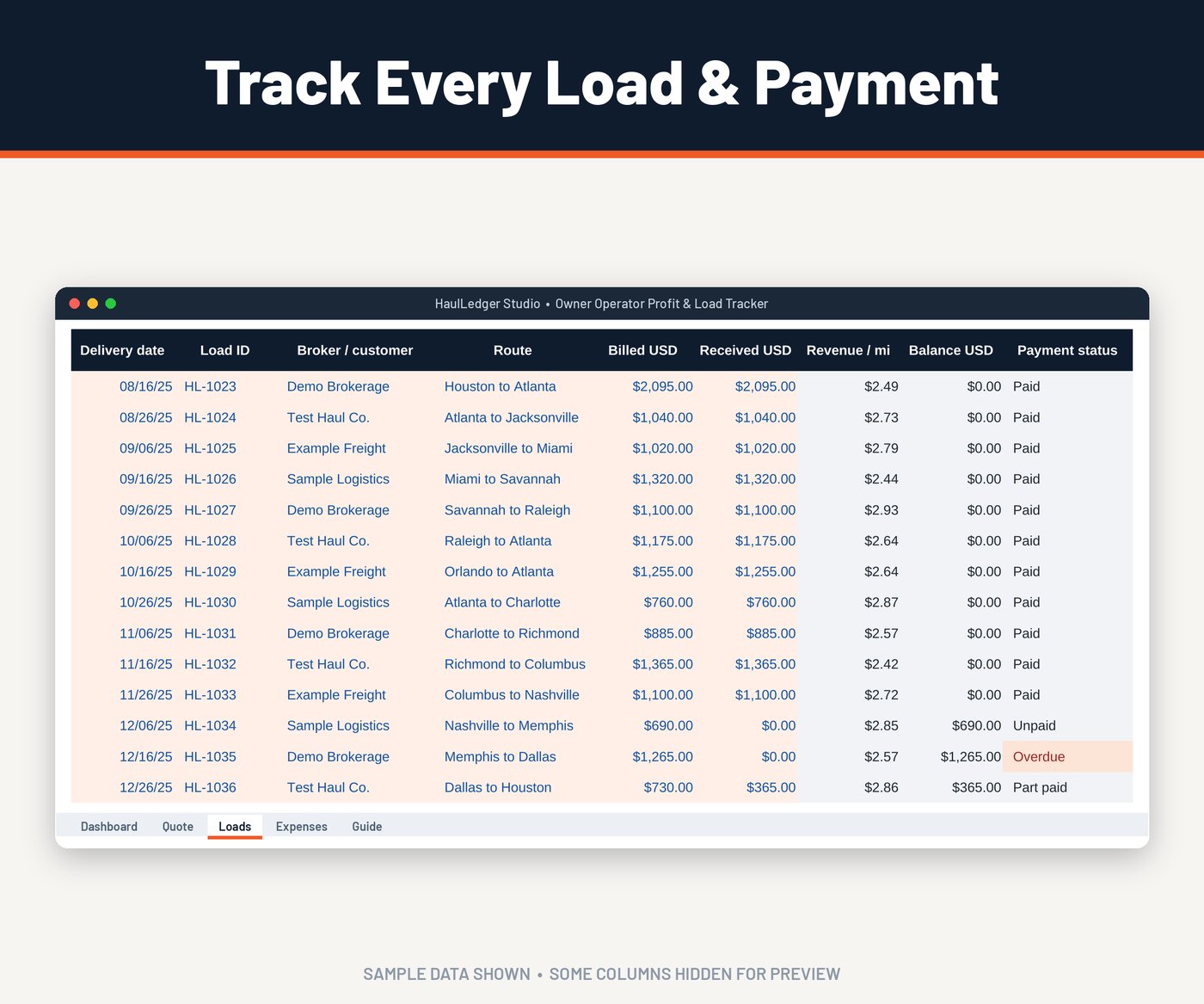
Know which loads have actually paid. The HaulLedger Owner Operator Profit & Expense Tracker logs every load’s billed and received amounts and flags unpaid, part-paid and overdue loads, next to your profit and cost per mile, in Excel or Google Sheets. It’s a load and payment log, not an invoice generator. Pair it with any trucking invoice template.
Trucking invoice template tips to get paid faster
- Invoice the same day you deliver, with the POD attached.
- Match the broker’s setup packet: the billing email, the subject line format (often the load number), and the documents they want.
- Check the math against the rate con before you send it. A mismatch is the most common reason for a hold.
- Follow up on day 31 if you’re on Net 30. Keep a log of who you talked to.
- Short-paid? Ask for the reason in writing. Under 49 CFR 371.3(c), each party to a brokered load has the right to review the broker’s record of that transaction.
- Need cash sooner? Quick pay or factoring can speed things up for a fee. Count that fee in your trucking cost per mile.
Trucking invoice template records: how long to keep them
- FMCSA’s records schedule lists paid freight bills at 1 year (49 CFR Part 379, Appendix A).
- The IRS generally wants records that support your income kept for 3 years after you file, and longer in some cases.
- Simple rule: keep every invoice, rate con, BOL and receipt for at least 3 years. Fuel receipts and mileage records have their own 4-year IFTA rule (see our IFTA calculator guide).
Trucking invoice template vs. a dispatch fee invoice
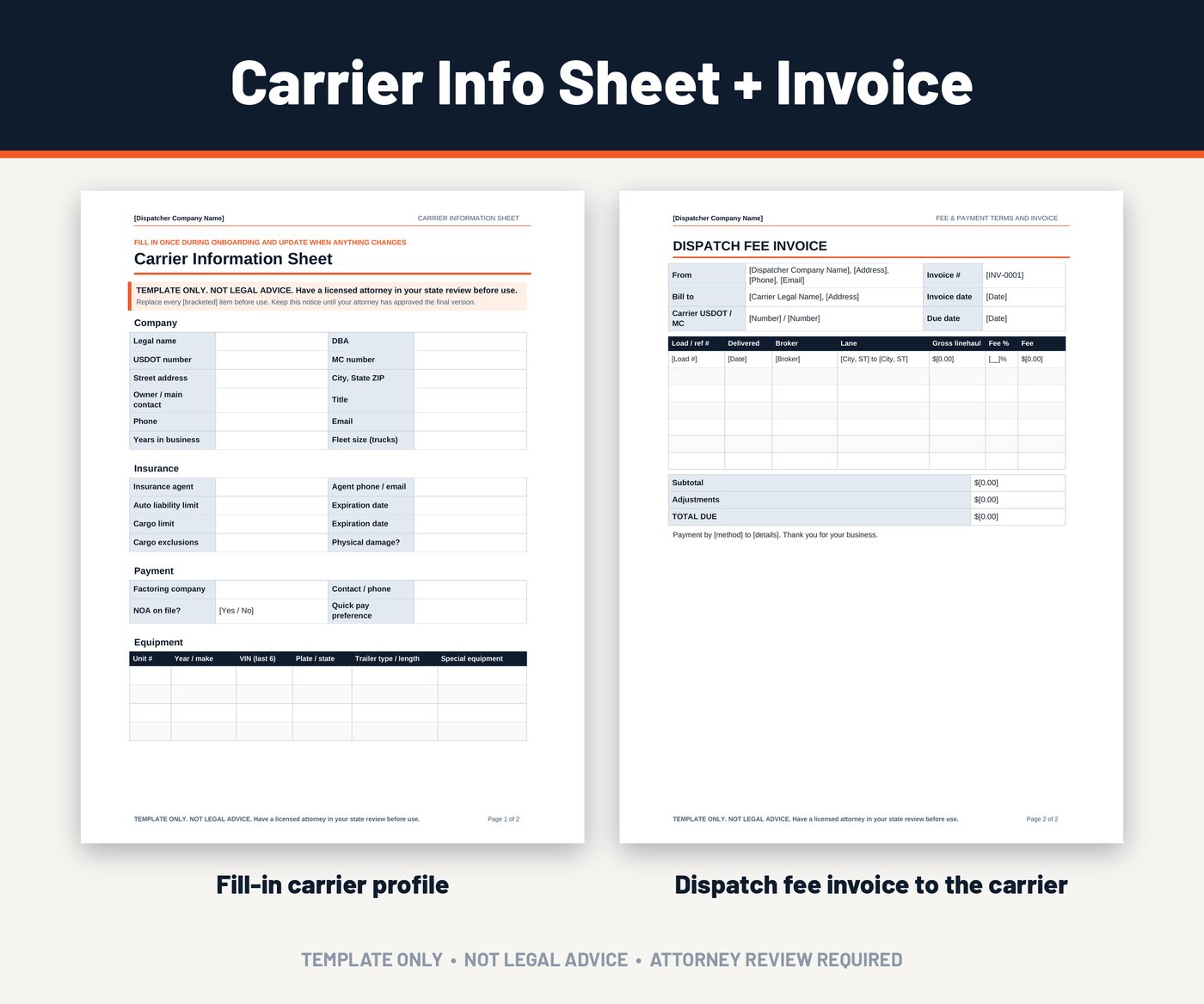
If you’re a dispatcher, you bill the carrier for your dispatch fee, not the broker for the freight. That invoice needs your fee terms, the loads it covers and the carrier’s signed dispatch agreement behind it. The HaulLedger Truck Dispatcher Bundle includes a Fee & Payment Terms sheet with a dispatch fee invoice, plus a dispatch service agreement and carrier onboarding forms.
Free: Know Your Number cost-per-mile calculator. See your break-even rate before you book a load.
Trucking invoice template FAQ
What should be included on a trucking invoice? Your company name, MC/USDOT and remit-to address, an invoice number and date, the bill-to party, load, PO and BOL numbers, pickup and delivery details, line haul and accessorial charges listed separately, the total, payment terms, and the signed rate con and POD attached.
How do I bill detention on a trucking invoice? Put detention on its own line with the hours past free time and the hourly rate from your rate con. Attach your in/out times, and tell the broker while the detention is happening.
What is a TONU charge in trucking? TONU stands for “truck ordered, not used.” It’s a fee for a load that’s canceled after you were dispatched. Get the amount agreed in writing.
Who pays lumper fees? Under 49 U.S.C. 14103, a shipper or receiver that requires loading or unloading help has to provide it or pay for it. You bill any lumper cost you paid, with the receipt.
How long do brokers take to pay? It depends on the terms in the rate con and the broker’s setup packet. 30 days is common, and many offer quick pay for a fee.
Can I make a trucking invoice template in Excel or Google Sheets? Yes. A spreadsheet or Word template works fine if it has every field above and you save each invoice as a PDF to send.
Do I need a separate invoice for each load? Most brokers want one invoice per load, referencing that load number. Check their setup packet.
Build your trucking invoice template once, then track every payment
Set up your trucking invoice template with the fields above, attach your proof every time, and log each invoice the day you send it. To see at a glance which loads are paid, unpaid or overdue, the Owner Operator Profit & Expense Tracker keeps billed vs. received for every load next to your profit.
Not legal or tax advice. Your rate confirmation and broker agreement control your rates, free time and payment terms. Check with a tax professional about record keeping for your business.
Sources (checked October 2026)
- eCFR, 49 CFR 373.103 (freight bill contents), 371.3 (broker records, right to review), Part 379, Appendix A (record retention)
- 49 U.S.C. 14103 (loading and unloading)
- FMCSA, Impact of Driver Detention Time on Safety and Operations
- U.S. DOT Office of Inspector General, Estimates Show Commercial Driver Detention Increases Crash Risks and Costs (ST2018019, Jan. 31, 2018)
- IRS, How long should I keep records?